



Weekend Moves Started With Bitcoin’s Recovery
Bitcoin entered the new week after a sharp weekend low. BTC dropped to $74,200 on Saturday, then recovered from that level and moved back up. It is now around $77,200, which shows that buyers stepped in after the weekend pressure.
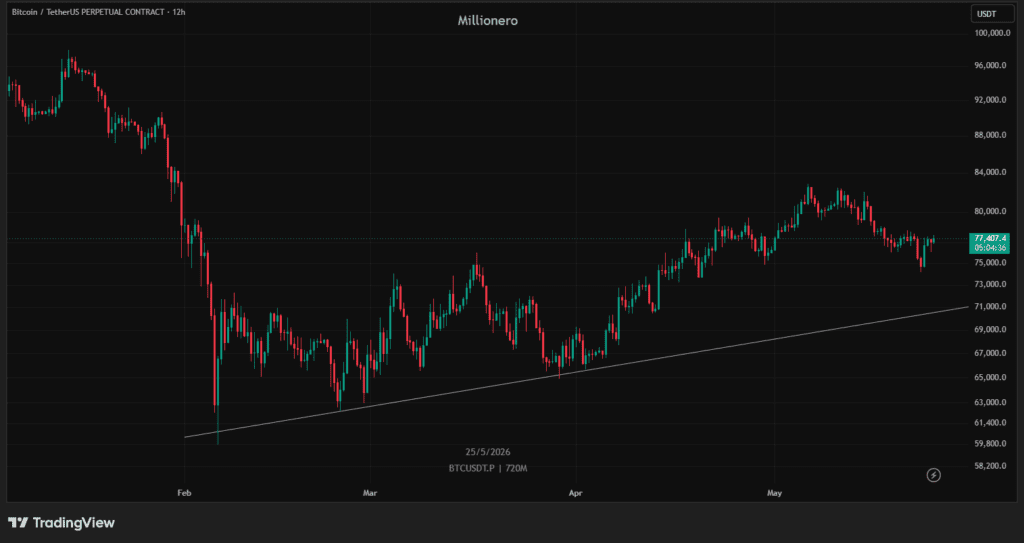
This recovery happened while broader markets were also reacting to major geopolitical headlines. The market mood improved after talk of a possible US-Iran peace deal, and that helped risk assets start the week with stronger momentum. At the same time, the situation remains uncertain because the deal has not been fully confirmed yet.
Markets Rally on US-Iran Peace Deal Optimism
The biggest weekend story was the possible agreement between the US and Iran. Markets reacted quickly to the idea that a deal could reduce geopolitical risk, lower oil pressure, and support equities.
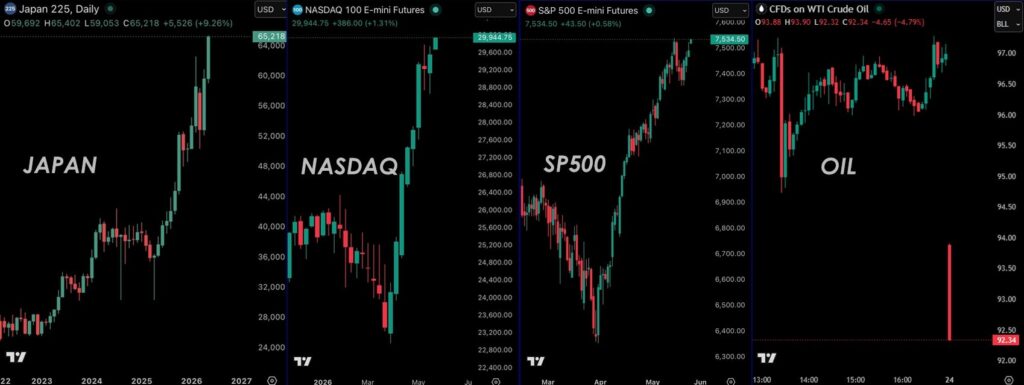
US stock futures moved sharply higher. S&P 500 futures surged to their highest level on record, while Nasdaq 100 futures rose 1.3% and also reached a record high. The broader market reaction was strong, with early moves showing:
- S&P 500: +0.6%
- Nasdaq 100: +0.7%
- Dow Jones: +0.5%
- WTI Crude: -5.0%
- Brent: -2.0%
- Gold: +1.0%
Japan also joined the risk-on move. Japan’s stock market gained 3.5% on the day and hit its highest level on record, supported by the same optimism around a possible US-Iran peace deal.
Oil moved in the opposite direction. US oil prices fell toward $92 per barrel, down more than 5%, as traders priced in lower geopolitical risk. This matters for markets because falling oil can reduce inflation pressure, especially if the decline continues. Lower energy prices can help soften the inflation story, which is important for future Federal Reserve rate decisions.
The Deal Is Still Not Certain
The optimism is strong, but the political picture is still mixed. US President Trump said a deal announcement was coming “shortly,” but later comments made the timing less clear. He said, “I can’t talk about the deal. It is totally up to me, and if there is any news, it will only be good news. I don’t make bad deals.”
Later, the White House no longer expected an agreement with Iran to be announced that same day. Officials said approval could take “several more days”, and while they remained optimistic, they also said the deal could still fall apart.
Trump also said he had told his representatives “not to rush into a deal” with Iran and that “time is on our side.”
Iran’s Fars News pushed back against the messaging around Trump’s posts. It said American officials had told Iran that Trump’s posts were mainly for promotional purposes and media consumption inside the US, and had advised that no attention should be paid to those statements.
So the market is starting the week with hope, but also with risk. A confirmed agreement could support equities and risk assets. A failed or delayed deal could bring back pressure, especially through oil prices and safe-haven demand.
MicroStrategy Chooses Debt Management Over New Bitcoin Buying
Another major weekend update came from MicroStrategy. The company, which remains the largest corporate Bitcoin holder, currently holds 843,738 BTC worth $64.45 billion.
Instead of buying more Bitcoin, MicroStrategy temporarily shifted focus toward retiring $1.38 billion of its 0% convertible notes due 2029 at an 8% discount. The move was funded partly by its high-yield STRC preferred stock.
This action saves the company around $120 million and helps avoid a possible $3 billion liquidity issue in 2027. It also reduces future share dilution. Supporters, including analyst Adam Livingston, praised the move because it can increase Bitcoin per share. Critics questioned the choice because the company is swapping cheap debt for costlier obligations unless Bitcoin rises strongly.
For Bitcoin, this matters because MicroStrategy is one of the biggest BTC-linked market stories. The company did not stop being bullish on Bitcoin, but this move shows that balance sheet management can sometimes take priority over direct BTC buying.
Ethereum Foundation Moves Toward a Smaller Role
Vitalik Buterin said the Ethereum Foundation is moving toward a more “streamlined” and less interventionist role in the broader Ethereum ecosystem.
He clarified that the Foundation will focus less on expansion and general control over the ecosystem. He also said the Ethereum Foundation plans to sell smaller amounts of ETH in the future. The Foundation currently holds only about 0.16% of the total supply.
This points to a direction where Ethereum becomes more independent from the centralized role of the Foundation. For the market, the key idea is simple: less control from the Foundation may support the long-term decentralization story, while smaller ETH sales may reduce one source of selling pressure.
Regulation, Stablecoins, and Real-World Crypto Risk Stay in Focus
The CLARITY Act also remained in focus. One possible impact is the rise of a new market called “Yield-as-a-Service.” According to Joe Vollono from STBL, this could become one of the biggest effects of the law because it may allow new financial yield models to be built on top of blockchain systems.
The idea is based on turning yields, storage, and interest into financial services that can be integrated more easily across crypto. This connects regulation with product growth, especially if clearer rules allow companies to build yield products in a more open way.
At the same time, European Central Bank officials warned about euro-pegged stablecoins. Their concern is that stablecoins could pull liquidity away from traditional banks. If deposits move from banks into stablecoins, banks may have less ability to fund the real economy. ECB officials also warned that fast stablecoin growth could make interest rate control more complex inside Europe.
Crypto security was another major topic. France now accounts for 70% of “Wrench Attacks” related to crypto worldwide. These attacks involve extortion and physical kidnapping to force victims to hand over digital assets. France recorded 41 crypto-related kidnappings in 2026, or roughly one operation every two and a half days. French organized crime prosecutor Vanessa Berrieh confirmed charges against 88 individuals linked to these cases.
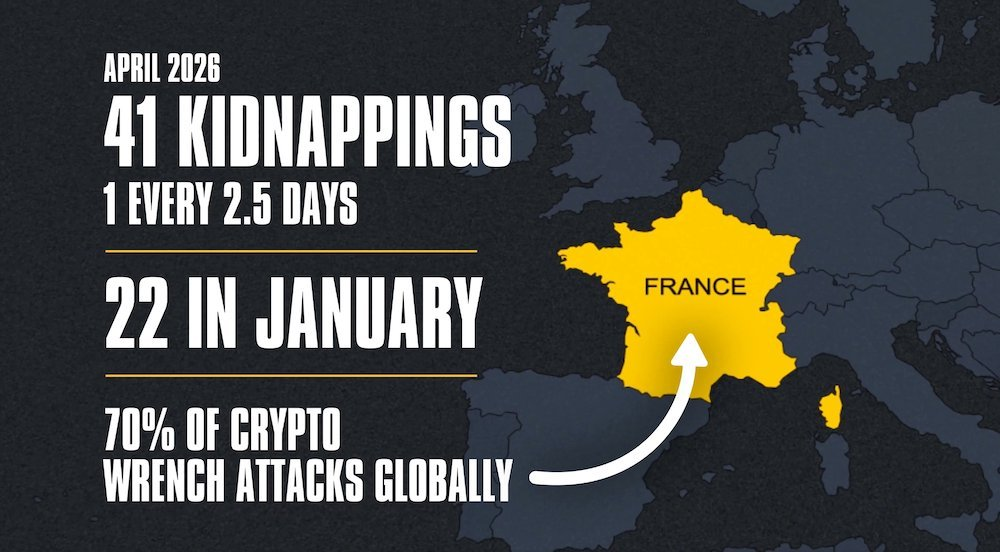
This shows that crypto security is no longer only digital. Leaks of centralized KYC data may be putting crypto holders at real-world physical risk.
Stablecoin security also came under pressure. EURR and USDR, the StablR-backed stablecoins, were exploited for nearly $10 million. Both assets crashed more than 20% off their price peg, creating panic. Reports said the attacker’s wallet was funded through CCTP on Noble, while the StablR team appeared inactive during the ongoing exploitation. This added more concern around stablecoins and multi-chain infrastructure.
The Upcoming Week: Short, Busy, and Data-Heavy
This is a short trading week because US markets are closed on Monday for Memorial Day. But the week is still packed with important events.
Key Events This Week:
- US-Iran Agreement Details – Expected Today
- US Markets Closed, Memorial Day – Monday
- May Consumer Confidence data – Tuesday
- April PCE Inflation data – Thursday
- US Q1 2026 GDP data – Thursday
- April New Home Sales data – Thursday
The most important day is Thursday, May 28. That is the danger day because the US releases several major numbers around 8:30 AM ET. These include PCE, Core PCE, Q1 GDP second estimate, durable goods, personal income/spending, jobless claims, and new home sales.
Why Thursday’s Data Matters for Bitcoin
The most important number is PCE inflation. PCE is important because it is closely watched for inflation trends, and March PCE was already hot at 3.5% year-over-year. The next official BEA release is scheduled for May 28.
BofA expects headline PCE +0.4% month-over-month / 3.8% year-over-year and core PCE +0.3% month-over-month / 3.3% year-over-year.
For BTC, the logic is clear. If PCE comes in hotter than those expectations, it strengthens the “higher rates / tighter liquidity” story. That is usually bad for Bitcoin because higher rates make liquidity tighter and reduce demand for risk assets.
If PCE comes in cooler than expected, BTC gets more room to bounce. Cooler inflation would support the idea that the Federal Reserve may have more space to cut rates later or at least avoid becoming more hawkish.
The labor data also matters. Jobless claims will show whether the labor market is still firm or starting to weaken. A strong labor market can give the Federal Reserve more reason to keep rates higher. A weaker labor market can increase pressure for easier policy, especially if inflation also cools.
The Q1 2026 GDP second estimate will show how strong the economy looks after revision. Strong GDP can support risk appetite, but if it comes with hot inflation, markets may worry about higher rates. Weak GDP with sticky inflation would be more difficult because it would raise stagflation concerns.
Durable goods, personal income/spending, and new home sales will also help shape the same picture. Markets want to know whether consumers are still spending, whether demand is still strong, and whether housing is holding up under higher rates.
Treasury Auctions and Options Expiry Add More Pressure
There are also Treasury auctions this week: 2-year on May 26, 5-year on May 27, and 7-year on May 28.
Weak auctions can push yields higher. Higher yields usually pressure BTC and other risk assets because they make liquidity conditions tighter and make safer assets more attractive.
The options market is also important this week. Attention is moving toward the May 29 expiry, with a reported $6.25B Deribit BTC options expiry, $75k max pain, and heavy call positioning around $80k–$82k.
This means market makers and options traders may have a reason to keep price pinned or choppy near these zones unless a real catalyst forces movement. The main catalyst could be Thursday’s data, especially PCE.
BTC is starting the week around $77,200, after recovering from $74,200. The next major move may depend on whether inflation data supports the bounce or pushes markets back into the higher-rates story.
Token Unlocks
Humanity (H)
Date: May 25
Unlock Value: 22.2M USDT
% of Circulating supply: 3.86%
Number of Tokens: 105M H
Plasma (XPL)
Date: May 25
Unlock Value: 7.4M USDT
% of Circulating supply: 3.69%
Number of Tokens: 88.89M XPL
Kamino (KMNO)
Date: May 30
Unlock Value: 4.6M USDT
% of Circulating supply: 3.16%
Number of Tokens: 229M KMNO
Sahara AI (SAHARA)
Date: May 26
Unlock Value: 4.5M USDT
% of Circulating supply: 4.06%
Number of Tokens: 132M SAHARA
GUNZ (GUN)
Date: May 31
Unlock Value: 4.2M USDT
% of Circulating supply: 14.53%
Number of Tokens: 354M GUN
This article is for educational purposes only and should not be taken as financial advice. Always do your own research before making any trading decision. For more simple crypto market explainers, visit the Millionero Blog, and explore crypto trading through Millionero Exchange.