


South Korea’s retail traders have found a new fire.
The same crowd that helped make Korea one of crypto’s loudest markets is now rushing into local stocks, AI chips, and the KOSPI’s record-breaking rally. The shift matters because Korean retail attention has always been a powerful market signal. When it gathers around one asset class, it can create speed, volume, leverage, and a full emotional cycle.
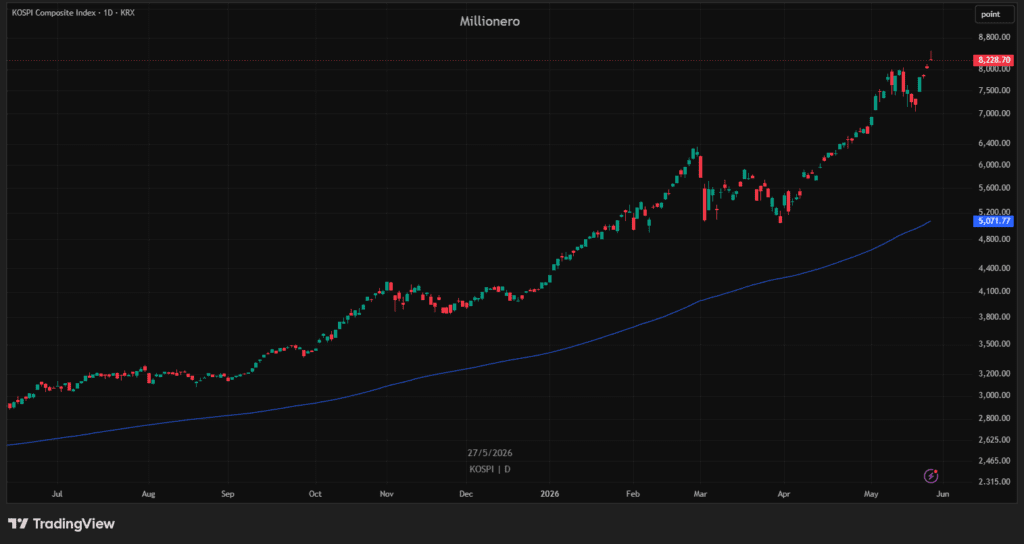
Right now, that cycle belongs to the KOSPI.
The Rally Has a Real Engine
The KOSPI’s rise has a clear center: AI memory chips. SK Hynix crossed a market value above $1 trillion on May 27, 2026, after its shares surged on booming demand for high-end memory chips used in AI hardware. Reuters reported that high-end memory chip prices doubled in Q1 and were expected to rise another 63% in Q2 because supply remained tight while AI data center demand stayed strong.
Samsung Electronics added fuel to the same story. Its unionized workers approved a pay deal that ended a five-month labor dispute and avoided a possible strike. The agreement included large bonuses for memory-chip workers, and Samsung shares rose after the news because investors saw less disruption risk during a crucial AI demand cycle.
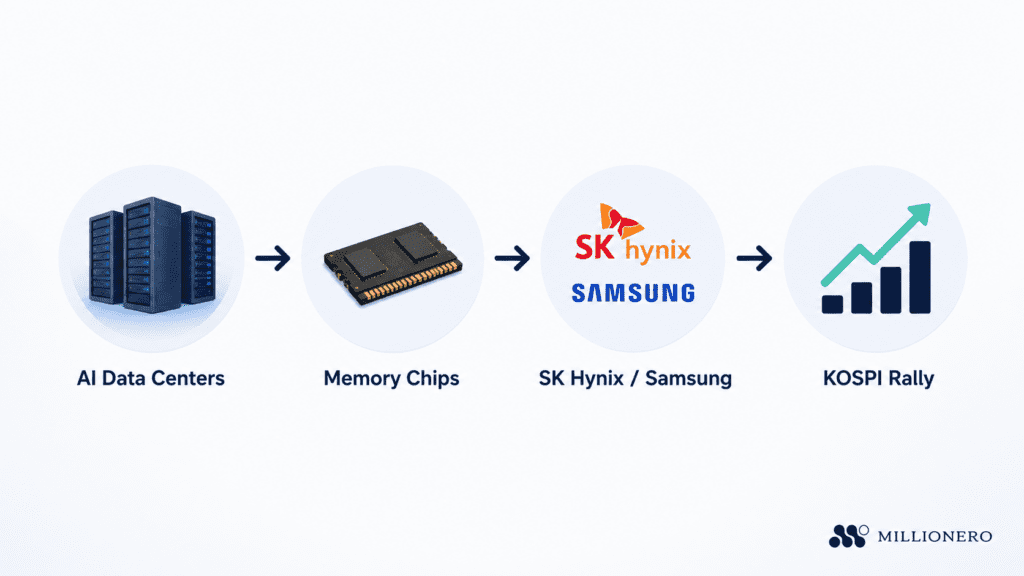
This gives Korean retail a simple market story: AI needs data centers, data centers need memory, and Korea owns two of the most important names in that chain.
That is a powerful sentence for a market. It is easy to understand. It is local. And it is visible on the chart.
A Stock Market Became a National Momentum Trade
Retail traders often chase price first and justify later. The KOSPI rally gives them plenty to justify.
South Korea has spent years trying to fight the “Korea discount,” the long-running problem where Korean stocks often traded cheaper than global peers because of weak governance, complex ownership structures, and poor shareholder returns. In March 2026, President Lee Jae Myung promised more reforms, including measures aimed at duplicate listings by holding companies and subsidiaries, a practice often blamed for hurting minority shareholders.
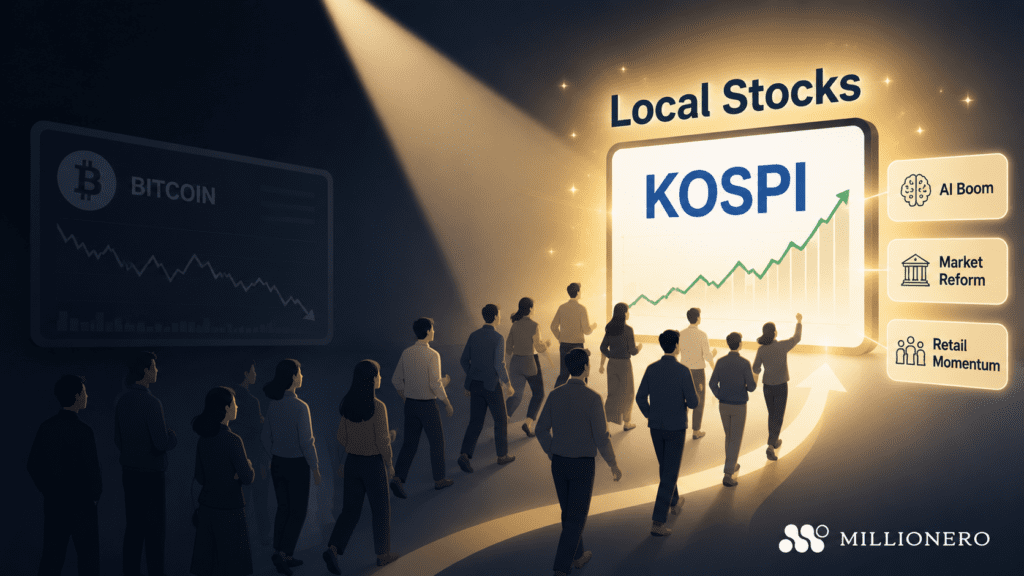
So the rally has two stories moving together. One is the AI chip boom. The other is the market reform story. Korean stocks are being priced as both a technology play and a governance re-rating play.
That combination can pull retail investors away from Bitcoin. Bitcoin gives Korean traders global volatility. The KOSPI now gives them local volatility with a national growth story attached.
Bitcoin’s Problem Is Attention
Korea has not lost its crypto culture. The Kimchi premium still matters because it measures the price gap between South Korean exchanges and global exchanges. High premium values can show strong Korean retail buying pressure for Bitcoin.
But attention has rotated.
Bitcoin once owned the emotional space of fast money in Korea. It had the late-night exchange screen, the altcoin rush, the premium, the sudden pumps, and the feeling that retail traders were closer to the future than traditional finance. The KOSPI is now offering a similar emotional package through a different door.
The difference is familiarity. Bitcoin is global and abstract. Samsung and SK Hynix are local and concrete. Korean investors can connect the rally to jobs, exports, national pride, and the AI race.
That makes the KOSPI feel less like a distant speculation and more like a domestic moment.
The Risk Is Crowding
The rally has strength, but it also carries heat.
Reuters Breakingviews reported that around 14 million retail investors have helped fuel South Korea’s stock-market surge. It also noted that nearly half of the KOSPI is now tied to AI leaders SK Hynix and Samsung, while leveraged ETFs and margin loans could intensify volatility if the trade turns.
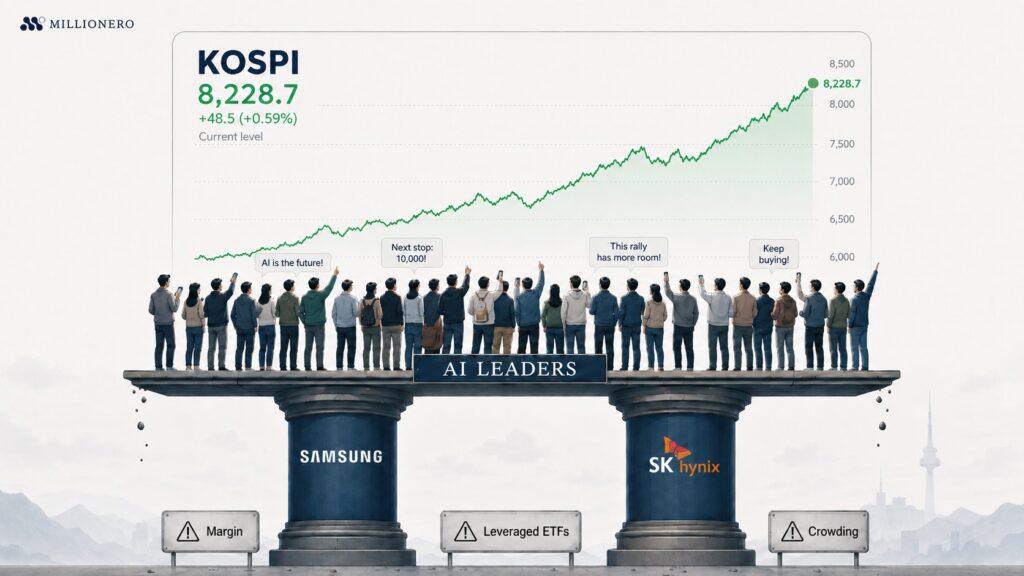
That is the weak point. When a market depends heavily on a few giant winners, the index can look healthier than it really is. If AI chip demand slows, if valuations stretch too far, or if leveraged traders are forced to sell, the same retail energy that pushed prices up can push prices down quickly.
What Comes Next?
Korean retail attention has shifted away from Bitcoin toward local stocks. The next stage depends on whether the KOSPI rally keeps receiving real fuel.
If AI earnings remain strong and reforms continue, Korean equities can keep holding attention. If the rally becomes too crowded, traders may start taking profit and searching for the next volatile market. That path could reopen space for Bitcoin, especially if the Kimchi premium begins rising again.
The most interesting outcome is rotation, not abandonment. Korean traders may treat local AI stocks as the domestic momentum trade and Bitcoin as the global liquidity trade. Both can attract the same type of investor at different moments.
For now, the KOSPI owns the room. Bitcoin has not been forgotten. It has been pushed to the side while Korean retail cheers for a faster chart closer to home.
This article is for educational purposes only and should not be taken as financial advice. Always do your own research before making any trading decision. To keep learning about crypto markets, visit the Millionero Blog, and explore digital assets through Millionero Exchange.