



A Heavy Weekend Left Bitcoin On The Back Foot
Bitcoin starts the new week under real pressure. BTC is trading around $73,300 on Monday morning, down close to 30% on the year, after a stretch of selling that pushed it back toward the low $70,000s. The mood is cautious rather than panicked, but the chart is fragile, and buyers have not been able to take back the $75,000–$77,000 zone that capped the market all of last week.
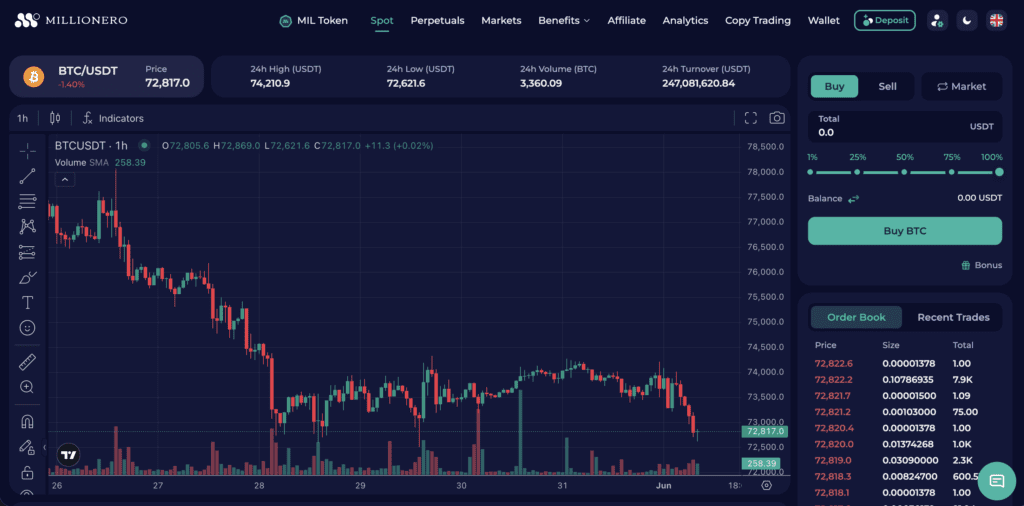
The bigger story behind the weakness is not crypto-specific. Stocks have been ripping higher on artificial intelligence optimism, with the S&P 500 posting its longest weekly winning streak since 2023. Bitcoin, Ethereum, XRP and Dogecoin all lagged that rally. Money that would normally rotate into crypto on a risk-on move has instead gone into equities, and that gap between Wall Street strength and crypto weakness is the clearest signal heading into this week.
Record ETF Outflows Are The Main Pressure Point
The single biggest weight on Bitcoin right now is its own ETFs. US spot Bitcoin ETFs lost about $2.97 billion over ten straight trading days through Friday, the longest outflow streak on record. That run wiped out a large share of 2026’s earlier inflows and turned the ETF complex from a steady buyer into a steady seller.
The headline event inside that streak was a roughly $1.29 billion exit from BlackRock’s IBIT, routed through a dark pool in a single session. Analysts read it as a fast exit by one large holder rather than a routine trade, and some desks pushed back on the idea that it was a simple basis-trade unwind because the discount was large and there was no matching spike in CME Bitcoin futures volume.
This matters because ETF flows have become the market’s clearest scoreboard for institutional demand. When redemptions force funds to sell real coins, that is genuine spot selling pressure, not paper shuffling. Until that flow turns positive again, rallies are likely to keep getting sold.
On top of the ETF story, around $2 billion in Bitcoin long positions were liquidated late last week as geopolitical headlines whipsawed risk appetite. That kind of flush removes leverage from the system, which can set up a cleaner bounce later, but in the moment it adds to the downside.
Markets Rally On A US–Iran Ceasefire MOU, But It Is Not Final
The dominant macro story is the US and Iran moving toward a deal. Negotiators reached a tentative 60-day memorandum of understanding to extend the existing ceasefire and open a new round of talks on Iran’s nuclear program. The agreement still needs sign-off from President Trump, and Iran has not publicly confirmed it.
Markets reacted before the ink was dry. The de-escalation hope helped power the equity rally and pulled oil sharply lower. Brent crude is trading near $92.50, down roughly 19% for the month of May, its steepest monthly drop in a long while, with US crude in the high $80s. Global oil is now down about 20% from its 2026 highs as traders price in a possible reopening of the Strait of Hormuz.
For crypto, lower oil is a double-edged sword. Falling energy prices ease one of the biggest inflation drivers of 2026, which over time could give the Federal Reserve more room to stay patient or eventually cut. But the picture is still uncertain: shipping traffic through Hormuz remains a fraction of pre-war levels, upstream production has to ramp back gradually, and any breakdown in the talks could send oil and safe-haven demand straight back up. The market is leaning optimistic, but it is leaning on an unfinished deal.
Strategy Cleans Up Its Balance Sheet Instead Of Buying
Strategy (formerly MicroStrategy), still the largest corporate Bitcoin holder, used cash reserves to retire about $1.5 billion of its convertible debt rather than add to its BTC stack. The point of the move is liability management: removing debt that carried a potential forced-liquidation timeline and replacing it with a cleaner balance sheet that extends how long the company can hold through volatility.
For the market, the read-through is the same as last week. Strategy has not turned bearish on Bitcoin. It is simply choosing to strengthen its financial position while prices are weak, which can matter a lot if this drawdown drags on. Long-duration holders tightening up while short-term ETF money exits is the defining split in this market right now.
Ethereum Is The Weakest Major
Ethereum is in worse shape than Bitcoin. ETH is trading around $2,000, and its spot ETFs have now seen roughly eleven straight days of net outflows, the longest withdrawal streak of 2026. When the regulated products stop buying, ETH loses its most stable source of demand and becomes more exposed to spot selling.
On-chain activity is not helping. Network usage has cooled sharply, with median transfer size and fees down heavily from their recent baseline, a sign of weak organic demand rather than just price-driven fear. There is also growing talk that the Ethereum Foundation needs a structural overhaul. Until flows and network activity turn, ETH looks like the higher-beta downside play in this market, and weakness there tends to drag the broader altcoin complex with it. XRP, for example, slipped to around $1.32 last week, a fresh multi-week low.
Banks Versus Crypto: The Stablecoin Yield Fight Heats Up
Regulation stayed in focus as the fight over the CLARITY Act framework turned personal. JPMorgan CEO Jamie Dimon publicly criticized Coinbase CEO Brian Armstrong and warned that the current framework could ultimately fail. The core clash is over whether stablecoin issuers should be allowed to offer yield-bearing rewards that look a lot like bank deposits.
This is the same tension the European Central Bank flagged recently: if stablecoins start paying yield and pulling deposits away from banks, it changes how the real economy gets funded and complicates monetary policy. The fight matters for crypto because the outcome will shape whether “yield on stablecoins” becomes a mainstream product or gets boxed in by regulators protecting the banking system.
Infrastructure And Security Risks Stay In The Picture
Network reliability came up again after the Sui blockchain halted three times within 48 hours. The Sui Foundation traced all three outages to a bug introduced in a recent upgrade, where a new address-balance feature interacted badly with the network’s existing gas and consensus logic. Repeated halts are a reminder that high-throughput chains still carry real operational risk.
On the crime side, a new report argued that criminals increasingly prefer stablecoins over Bitcoin, suggesting the old “Bitcoin is the currency of crime” narrative is becoming outdated as illicit activity shifts toward dollar-pegged tokens on fast, cheap rails.
The Upcoming Week: It Is Jobs Week
US markets are open all week — Memorial Day was last Monday, May 25 — and the calendar is built almost entirely around the labor market. This is the first full “jobs week” of the month, and it ends with the single most important release of the period.
Key Events This Week:
- Monday, June 1 — ISM Manufacturing PMI (May), final S&P Global Manufacturing PMI, Construction Spending (10:00 AM ET)
- Tuesday, June 2 — JOLTS Job Openings (April), Factory Orders
- Wednesday, June 3 — ADP National Employment (May, 8:15 AM ET), ISM Services PMI (10:00 AM ET), Fed Beige Book
- Thursday, June 4 — Challenger Job Cuts, Initial Jobless Claims (8:30 AM ET), Trade Balance, final Productivity and Unit Labor Costs
- Friday, June 5 — Nonfarm Payrolls (May), Unemployment Rate, and Average Hourly Earnings (8:30 AM ET)
The danger day is Friday, June 5. The Bureau of Labor Statistics has confirmed the May employment report for 8:30 AM ET that day, and it is the last major read on the labor market before the Federal Reserve’s next meeting on June 16–17.
Why Friday’s Jobs Report Matters For Bitcoin
The May jobs report is the catalyst that could break Bitcoin out of its range in either direction.
For context, April payrolls came in at +115,000, above the muted forecast, with the unemployment rate holding at 4.3% and average hourly earnings up about 0.3% month-over-month. The takeaway has been a labor market that is slowly cooling but still resilient. Economists broadly expect another modest reading for May.
The logic for BTC is straightforward. A hotter-than-expected report — strong job growth and firm wages — strengthens the “higher rates for longer” story. That tends to tighten liquidity and pressure risk assets like Bitcoin, especially with the Fed already on hold at 3.50%–3.75% and rate cuts pushed off the table for now.
A cooler-than-expected report — weak payrolls and softer wages — does the opposite. Combined with oil falling on the Iran ceasefire hopes, a soft jobs print would feed the argument that inflation pressure is easing and the Fed has more room to stay patient or eventually ease. That is the scenario that would give Bitcoin the most room to bounce.
The tricky outcome is weak job growth alongside sticky wages. That mix raises stagflation worries and is the hardest backdrop for risk assets, because it pressures the Fed without giving it a clean reason to cut. The earlier-week data — ISM surveys, JOLTS openings, ADP, jobless claims and Challenger layoffs — will shape expectations into Friday, but the payrolls number is the one that moves the market.
Yields, The Fed Clock, And Quieter Options
Treasury yields remain a key transmission channel. If the labor data runs hot and yields push higher, that usually tightens liquidity and weighs on BTC by making safer assets more attractive. If the data cools and yields ease, Bitcoin gets some breathing room.
There is also a Fed clock running. With the June 16–17 FOMC meeting approaching, this jobs report is effectively the committee’s final big labor input before the blackout period begins, which raises the stakes for how markets interpret Friday.
On the derivatives side, the pressure is lighter than last week. The large monthly Deribit options expiry already cleared on May 29, so this week features only smaller weekly expiries. That removes one source of pinning and choppiness and hands even more influence to the macro data — above all, PCE’s cousin this month, the jobs report.
Bottom line: Bitcoin is starting the week near $73,300, weighed down by record ETF outflows and a risk-on stock market that is leaving crypto behind. The next real move likely depends on Friday’s jobs data and on whether the US–Iran deal gets confirmed or falls apart.
Token Unlocks
Hedera (HBAR)
- Date: June 1
- Unlock Value: ~$68.38M
- % of Supply: 2.55%
- Number of Tokens: ~1.27B HBAR
1inch (1INCH)
- Date: June 2
- Unlock Value: ~$101M
- % of Supply: 16.65%
- Number of Tokens: ~249.8M 1INCH
Sui (SUI)
- Date: June 3
- Unlock Value: ~$64.93M
- % of Supply: 0.61%
- Number of Tokens: ~61.08M SUI
Nym (NYM)
- Date: June 2
- Unlock Value: ~$4.93M
- % of Supply: 2.5%
- Number of Tokens: 25M NYM
Acala (ACA)
- Date: June 1
- Unlock Value: ~$1.29M
- % of Supply: 2.74%
- Number of Tokens: ~27.4M ACA
This article is for educational purposes only and should not be taken as financial advice. Always do your own research before making any trading decision. For more simple crypto market explainers, visit the Millionero Blog, and explore crypto trading through Millionero exchange.