



In a single day, the crypto market watched more than a billion dollars in trading positions vanish. Bitcoin tumbled below $63,000 for the first time since February, dragging the rest of the market down with it, and as prices fell through one support level after another, exchanges automatically closed out billions of dollars in leveraged bets. If you have ever wondered how a price drop of a few percent can wipe out over a billion dollars in a matter of hours, the answer is liquidations. This article breaks down exactly what happened, what a liquidation actually is, and why these events snowball the way they do.
What Just Happened
The selloff was sharp and fast. Bitcoin slid below $63,000, its lowest level in months, briefly dipping under $62,000 during the worst of the move. That left it down more than 13 percent on the week and roughly 50 percent below the all time high near $126,000 that it set in October 2025. Ethereum followed the majors lower, sliding under $1,800, and the broader market cap shrank alongside them.
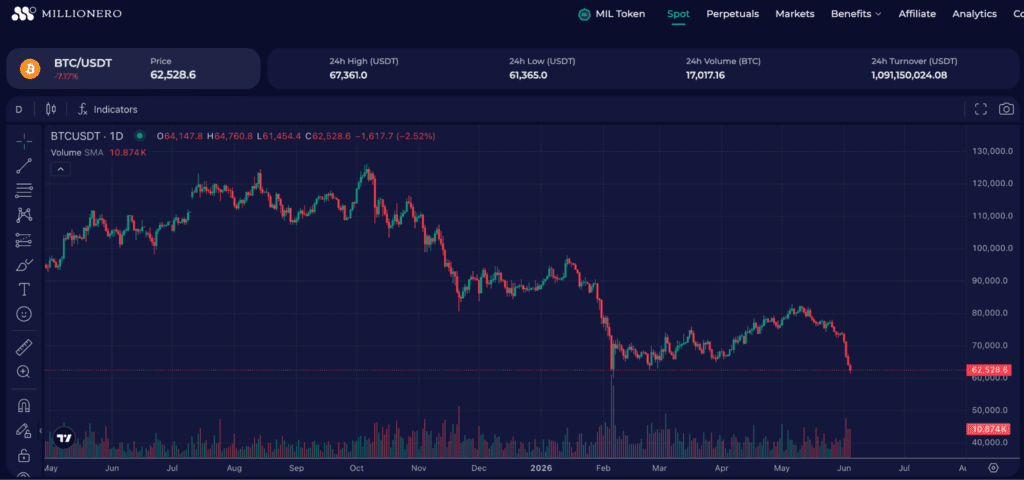
As prices broke down, the forced selling began. More than one billion dollars in leveraged positions were liquidated within 24 hours, with some trackers putting the figure even higher. The overwhelming majority of those liquidations came from long positions, meaning traders who had bet on prices going up were the ones caught on the wrong side. Sentiment collapsed in step with the price, with the Crypto Fear and Greed Index sinking into extreme fear territory.
What Is a Liquidation?
To understand the billion dollar number, you first have to understand leverage.
When you trade with leverage, you borrow money to open a position larger than your own capital would normally allow. If you put up $1,000 and trade at ten times leverage, you are controlling a $10,000 position. That borrowed money magnifies your gains when the trade goes your way, but it magnifies your losses just as powerfully when it does not.
A liquidation is what happens when a leveraged trade moves so far against you that your collateral can no longer cover the potential loss. At that point, the exchange does not wait politely for you to add more funds. It automatically closes your position to protect the borrowed capital. Your collateral, often called margin, is consumed, and the position is gone. The more leverage you use, the smaller the price move needed to trigger this. A position at twenty times leverage can be wiped out by a move of just a few percent against it.
Long Liquidations and Short Liquidations
There are two sides to this. A long position profits when price rises, so it gets liquidated when price falls far enough. A short position profits when price falls, so it gets liquidated when price rises. In this selloff, the market was crowded with longs betting on a continued bull run, which is exactly why the falling price triggered such a heavy wave of long liquidations rather than short ones.
Why It Snowballs Into Billions
Here is the part that turns a normal pullback into a billion dollar event. Liquidations are not just losses for individual traders. They are forced market orders.
When an exchange liquidates a long position, it sells that position into the market. That selling pushes the price down a little further. A slightly lower price then breaches the liquidation level of the next batch of leveraged longs, which triggers more forced selling, which pushes the price down again. This self reinforcing loop is known as a liquidation cascade, and it is the reason these events happen so violently and so quickly. Each wave of forced selling becomes the trigger for the next, like dominoes falling in sequence.
It works in reverse during sharp rallies too, when a wall of short liquidations can send price spiking upward in what traders call a short squeeze. Either way, leverage is the fuel and the cascade is the fire.
What Lit the Fuse This Time
A cascade still needs a spark, and several pressures converged at once.
The biggest was sustained institutional selling. Spot Bitcoin exchange traded funds recorded one of their longest outflow streaks on record, with roughly $3.45 billion pulled out over nearly two weeks, a clear sign that large players were quietly reducing risk well ahead of the price drop. That pressure was amplified by a symbolic disclosure that Michael Saylor’s firm, Strategy, had sold a small amount of Bitcoin, which rattled a market that had come to view the company as a permanent holder.
The macro backdrop did the rest. A cautious Federal Reserve, anticipation around upcoming United States jobs data, a rotation of money into artificial intelligence stocks, and geopolitical tension all pushed investors toward a risk off mood. With profit takers already trimming positions after the previous rally, the market was primed for exactly the kind of leveraged unwind that followed.
What Traders Can Learn From This
Liquidation events are brutal, but they are also predictable in their mechanics, and that makes them a teaching moment.
The clearest lesson is about leverage itself. The traders who got wiped out were not necessarily wrong about the long term direction. They were simply overexposed, holding positions so large relative to their collateral that an ordinary correction was enough to end them. Using lower leverage gives a position room to breathe through normal volatility. Sizing positions sensibly, so that no single trade can do serious damage, matters far more than being right about direction.
A defined stop loss is the other key tool. Choosing your own exit in advance is almost always better than letting the exchange choose it for you through liquidation, because a planned stop can be placed thoughtfully while a liquidation happens at the worst possible moment in a cascade. It is also worth watching market wide signals, since extreme leverage and one sided positioning tend to build up before these unwinds, leaving the market fragile and ready to tip.
As for where the market goes next, analysts are watching the $60,000 level closely as the next major support, with deeper zones toward $55,000 and $50,000 in focus if it fails. Nobody can predict the bottom with certainty, and that uncertainty is precisely why managing leverage and risk matters more than chasing a forecast.
The Takeaway
A billion dollars did not disappear because a billion dollars of value was destroyed. It disappeared because borrowed money, stacked high across thousands of leveraged positions, was forcibly unwound the moment prices broke key levels. Liquidations turn a sharp move into a violent one, and understanding how they cascade is one of the most useful things a trader can carry into a volatile market. Respect leverage, define your risk before you enter, and remember that in moments like these, the traders who survive are usually the ones who never gave the market the chance to liquidate them in the first place.
Ready to trade with the tools to manage your risk? Trade on Millionero exchange.
This article is for educational purposes only and does not constitute financial or investment advice. Trading cryptocurrencies carries significant risk, and leveraged trading can result in the loss of your entire investment. Always do your own research before making any trading decision.