



A chart can show you where a coin is moving, but liquidity tells you whether you can enter or escape without getting hurt.
That is where many crypto trades become real. The price looks clean on the screen. The candle looks strong. The setup feels simple. Then the order touches the market, and the trader receives a worse entry than expected. The gap appears through slippage, a wide spread, or a thin order book.
Liquidity is the reason behind that gap.
In crypto, liquidity means how easily an asset can be bought or sold without causing a sharp change in price. A liquid market has enough active buyers and sellers to absorb trades smoothly. A weakly liquid market feels fragile. Even a moderate order can push the price away from the trader.
For beginners and intermediate traders, liquidity is one of the most practical concepts in the market. It affects execution, risk, volatility, and the final result of a trade.
What Liquidity Means in Crypto
The Simple Meaning
Liquidity shows how easy it is to trade at a fair price.
Bitcoin and Ethereum usually have strong liquidity because many traders, institutions, and market makers are active around them. If BTC trades around $80,000, a normal-sized order can usually fill close to that price.
A small token can behave differently. The chart may show $1.00, but the order book may have limited supply near that level. A trader trying to buy a larger amount may fill part of the order at $1.00, another part at $1.03, and the rest at $1.07. The final average price becomes much higher than the price that first appeared on the screen.
That difference is the cost of weak liquidity.
Market Liquidity and Funding Liquidity
Traders usually feel market liquidity first. It describes how easily they can buy or sell an asset.
There is also funding liquidity, which means the availability of cash, stablecoins, collateral, or margin that supports trading. In crypto, stablecoins such as USDT and USDC often act as the fuel behind market activity. When capital is available, market makers can quote better prices and traders can move with more confidence. When capital tightens, spreads can widen and order books can thin quickly.
Healthy liquidity gives the market room to breathe. Weak liquidity makes every larger trade feel heavier.
How Liquidity Appears on an Exchange
The Order Book
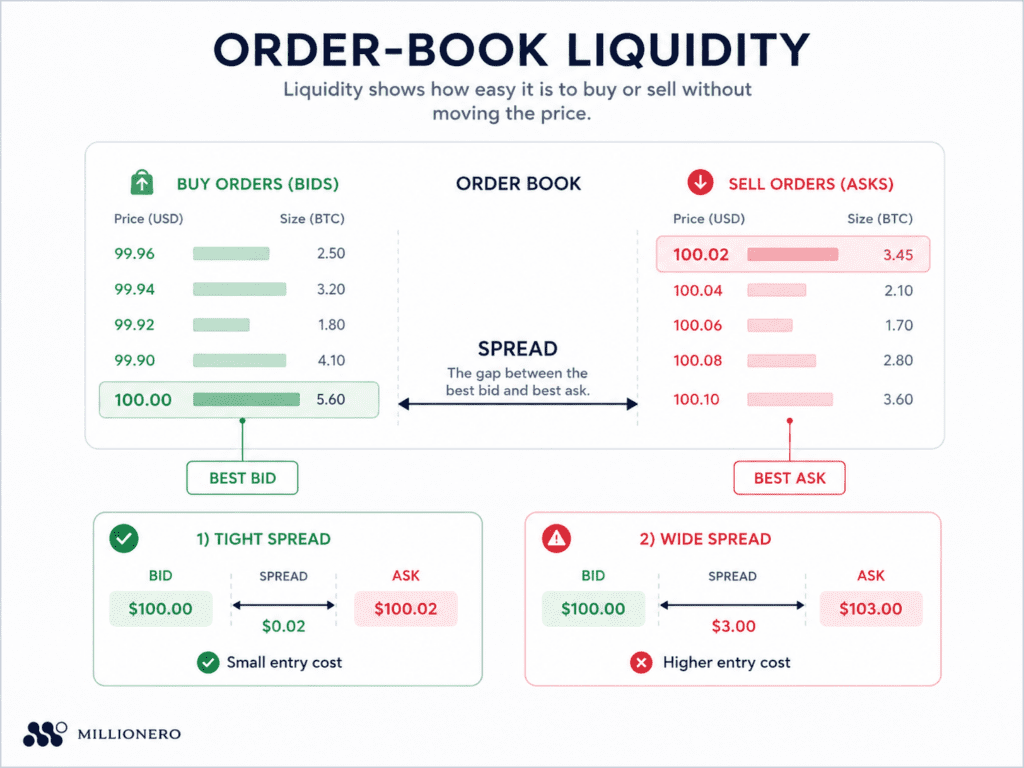
On many crypto exchanges, including ours, liquidity appears through the order book. The order book shows buy orders and sell orders waiting at different prices.
The highest buy price is called the best bid. The lowest sell price is called the best ask. The gap between them is the spread.
A tight spread usually signals better liquidity. For example, if a coin has a bid of $100.00 and an ask of $100.02, the entry cost is small. If another coin has a bid of $100.00 and an ask of $103.00, the trader faces a large cost before the market even moves.
Depth and Slippage
Spread gives the first clue. Depth gives the deeper picture.
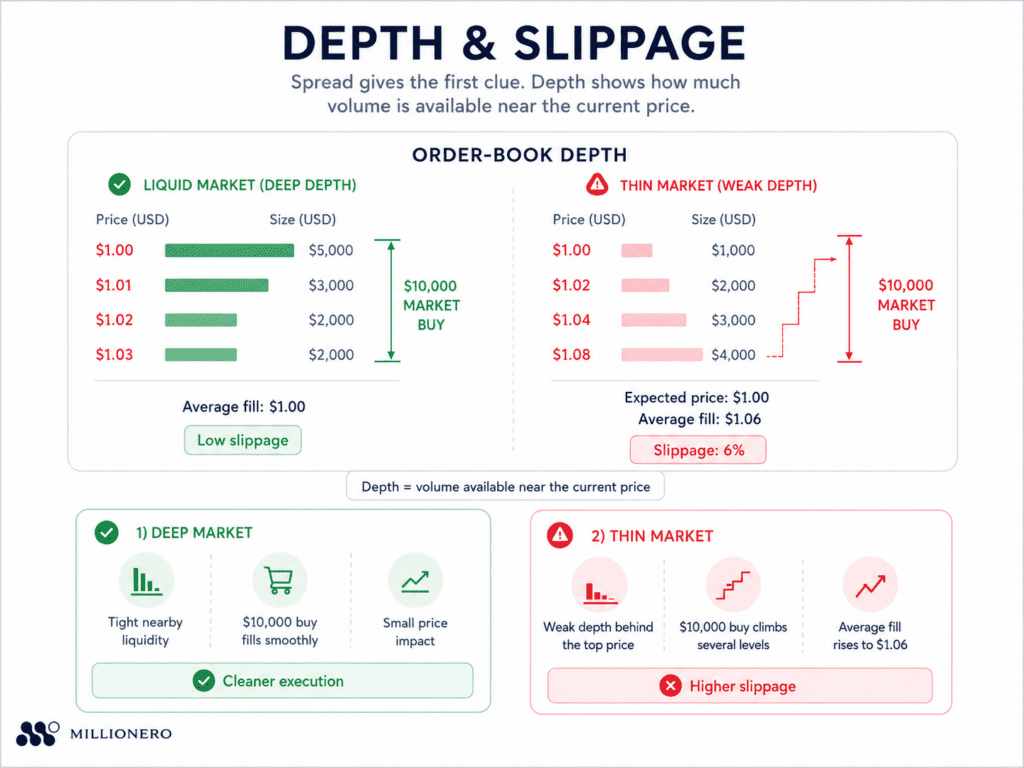
Depth means how much volume is available near the current price. A market may show a decent top price while still having weak depth behind it.
Suppose a trader wants to buy $10,000 worth of a liquid coin. If enough sell orders exist near the current price, the order can fill smoothly. In a thin market, that same order may climb through several price levels. The trader expected $1.00. The final average fill becomes $1.06.
That 6% difference is called slippage. It can damage a trade before the price has time to move in the trader’s favor.
Why Liquidity Matters for Traders
It Shapes the Real Entry
Many traders plan from the chart. They mark support, resistance, breakout areas, and targets. Good planning matters, yet execution decides the real trade.
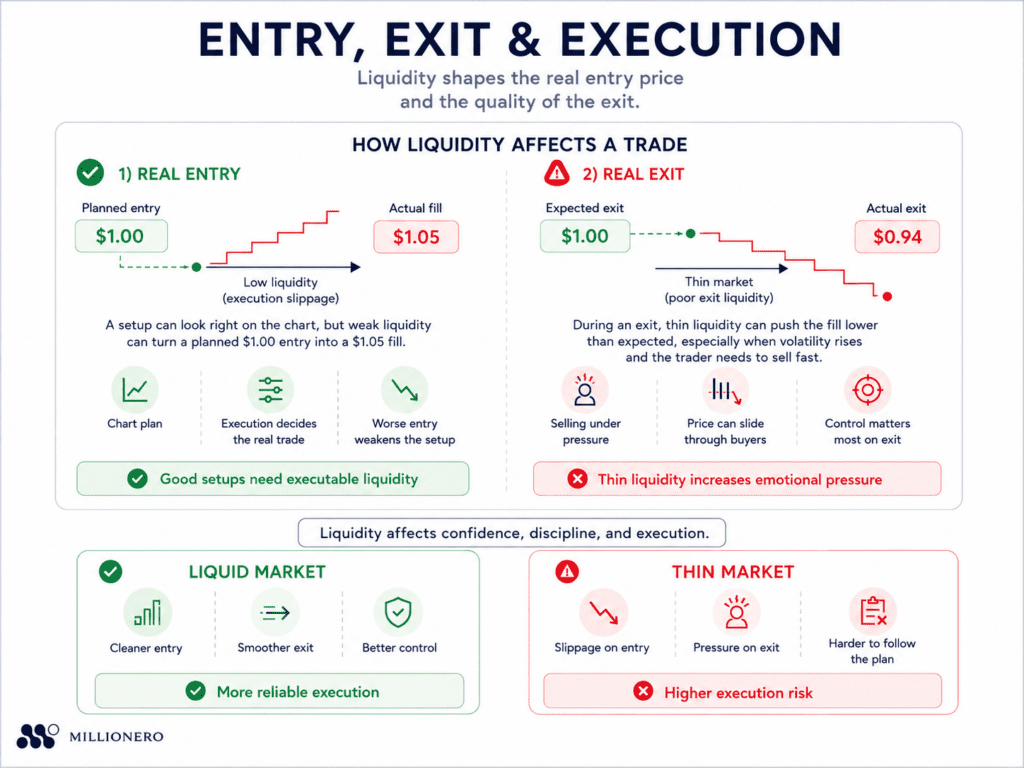
A trader may plan an entry at $1.00. Low liquidity may turn that entry into $1.05. The idea stays the same, but the trade becomes weaker because the entry is worse.
This is why experienced traders respect execution. A good setup needs a market that can actually carry the order.
It Shapes the Exit
Liquidity becomes even more important during an exit.
Entering a trade often feels calm. Exiting can happen under pressure. The market may be falling. The trader may need to cut a loss. Volatility may be rising.
In a liquid market, there are usually enough buyers to absorb a sell order. In a thin market, the exit can slide lower than expected. The trader loses control at the exact moment control matters most.
That is the emotional side of liquidity. It affects confidence, discipline, and the ability to follow a plan.
Why Low Liquidity Can Be Dangerous
Sharp Moves and Strange Wicks
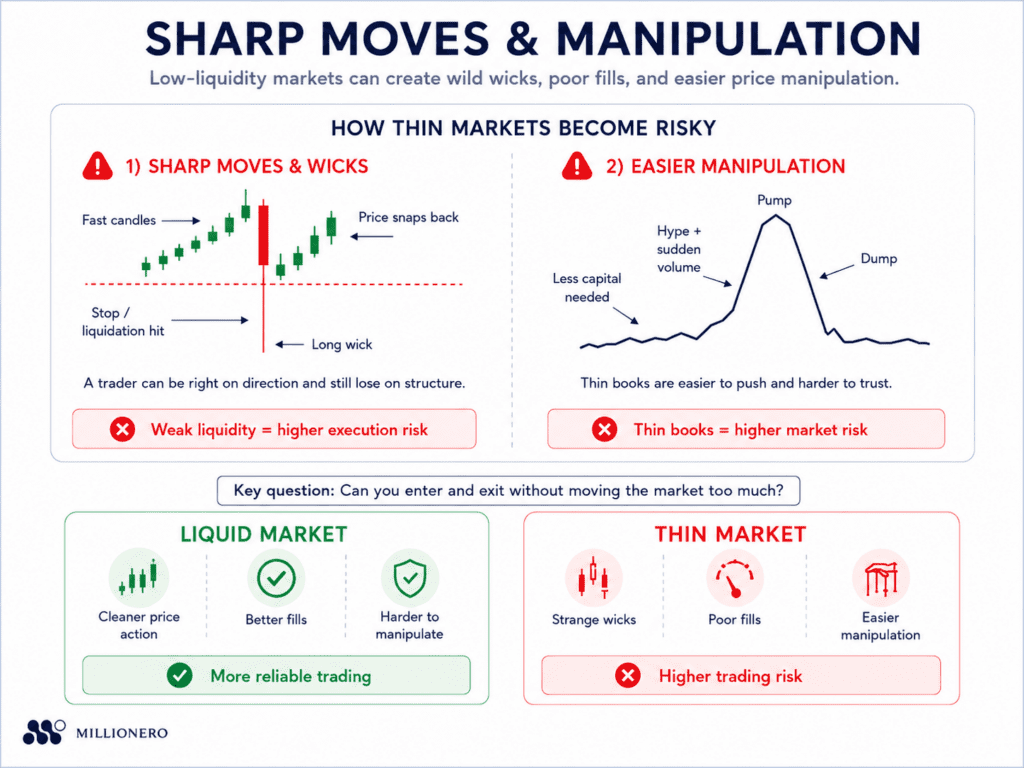
Low-liquidity markets often create strange price action. Candles jump quickly. Wicks stretch far. A single order can push the chart into extreme areas.
For spot traders, this can mean poor entries and exits. For leveraged traders, it can mean liquidations. A fast wick can hit a stop-loss or liquidation level, then return near the original price.
The trader may understand the direction correctly and still lose because the market structure was weak.
Easier Manipulation
Thin markets are easier to move. When fewer buyers and sellers are active, less money is needed to push the price. This can attract pump-and-dump behavior, especially in small tokens with shallow order books.
A token may show hype, green candles, and sudden volume. The useful question is simple: can real traders enter and exit without moving the market too much?
If the answer is weak, the risk is higher.
How Traders Can Check Liquidity
Before placing a trade, traders can check a few simple signs:
- Spread: Is the gap between bid and ask small?
- Depth: Is there enough volume near the current price?
- Slippage: How much would your usual order size move the market?
- Pair quality: Is liquidity stronger on USDT, USDC, BTC, or another pair?
Market orders give speed. Limit orders give control. For larger trades, smaller order sizes can reduce slippage and make execution cleaner.
Final Thoughts
Liquidity is the hidden structure beneath every crypto trade. It shapes the entry, the exit, the cost, and the risk.
A trader who understands liquidity sees the market with clearer eyes. The chart still matters, but the order book tells a second story: how much support exists behind the visible price.
For beginners and intermediate traders, this habit can save real money. Before entering a trade, look at liquidity. It may protect you from bad fills, weak exits, and markets that look calm until your order exposes their fragility.
Millionero’s blog is here to help traders understand crypto concepts before putting real money at risk. This article is for educational purposes only and should not be taken as financial advice. Always do your own research, manage risk carefully, and when you are ready to trade, you can explore spot and futures markets on Millionero. Follow our Blog for more!