


The hardest trade to avoid is the one that seems to be leaving without you.
Every trader knows the feeling. A coin begins to move. The candles grow taller. The chart starts breathing like a living thing. Social media turns louder by the minute. Screenshots appear. Price targets spread. Confident voices fill the feed. Suddenly, the trade no longer feels optional. It feels like a door closing.
That is where FOMO begins.
In crypto, FOMO can become expensive fast because price moves quickly and attention moves even faster. A trader can begin the day calm, careful, and disciplined, then enter a position only because Bitcoin is breaking out, ONDO is running, or SOL is pushing against resistance. The danger appears when the trade comes from pressure instead of a plan.
When the Chart Starts Feeling Personal
FOMO usually begins with regret.
A trader sees a move and thinks, I saw this earlier. I should have entered. That thought creates heat. The heat becomes a story. The story begins collecting excuses. A bullish post becomes confirmation. A large green candle becomes proof. A price target becomes comfort.
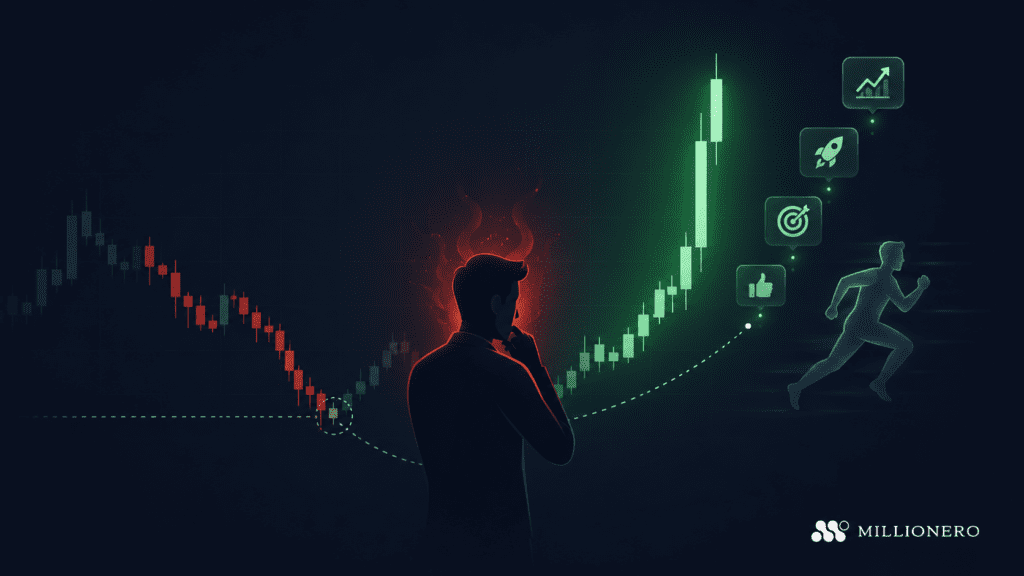
This is how FOMO changes the mind. It turns analysis into a chase.
A calm trader asks clear questions:
- Where is my entry?
- Where is my invalidation?
- How much am I risking?
- Has the move already stretched too far?
A trader under FOMO keeps hearing one question: What if it keeps going without me?
That question has no natural end. A coin can always go higher. A narrative can always become louder. A breakout can always attract more buyers. FOMO feeds on that open space between possibility and panic.
Why Loud Moves Create Bad Entries
The loudest part of a move often comes after the cleanest entry has already passed.
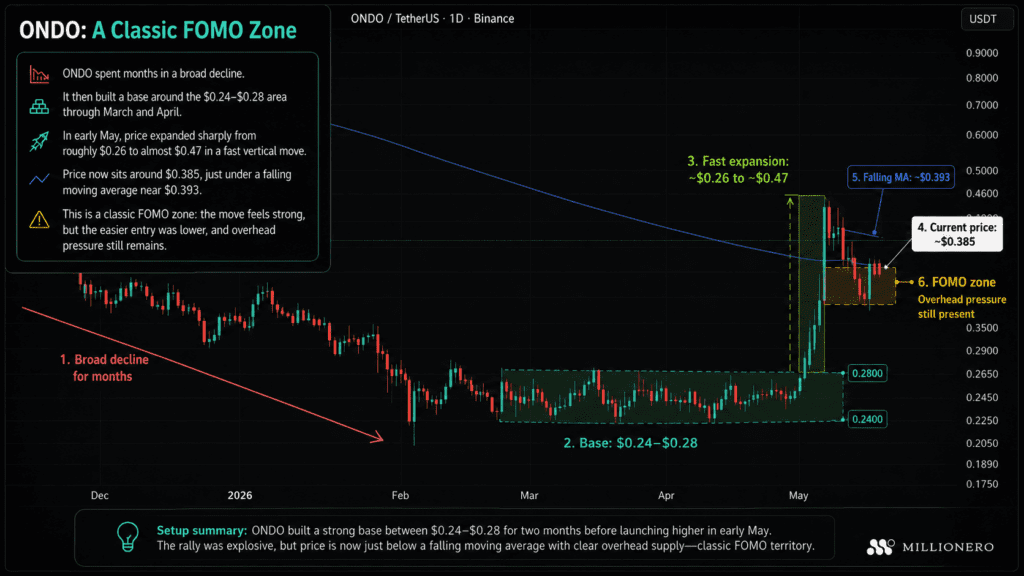
A token like ONDO shows this clearly. On the chart, ONDO spent months in a broad decline, then built a base around the $0.24 to $0.28 area through March and April. In early May, price expanded sharply from roughly $0.26 to almost $0.47 in a fast vertical move. That kind of candle attracts emotional entries immediately. Now price sits around $0.385, right under a falling moving average near $0.393. This is a classic FOMO zone. The move feels strong, but the easy entry already happened lower, and overhead pressure is still present.
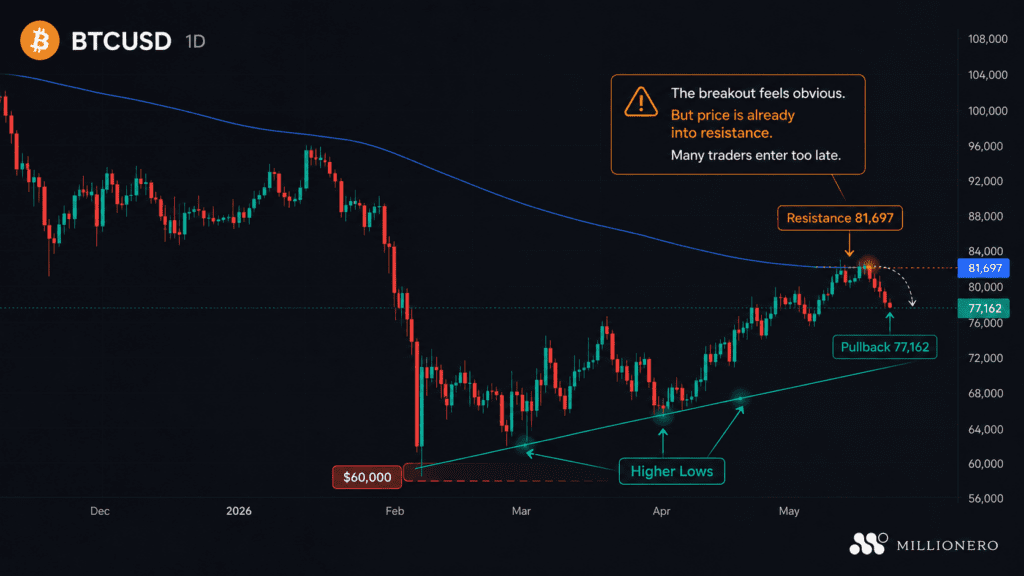
Bitcoin creates the same pressure at a larger scale. On the chart, BTC recovered strongly after the February drop toward the $60,000 area and then built a series of higher lows. That recovery pushed price back toward the $80,000 to $82,000 zone in May. The problem is clear on the chart: BTC ran directly into a descending moving average near $81,697 and then pulled back to around $77,162. A trader who buys because the breakout suddenly feels obvious can end up entering straight into resistance, then sitting through the retrace almost immediately.
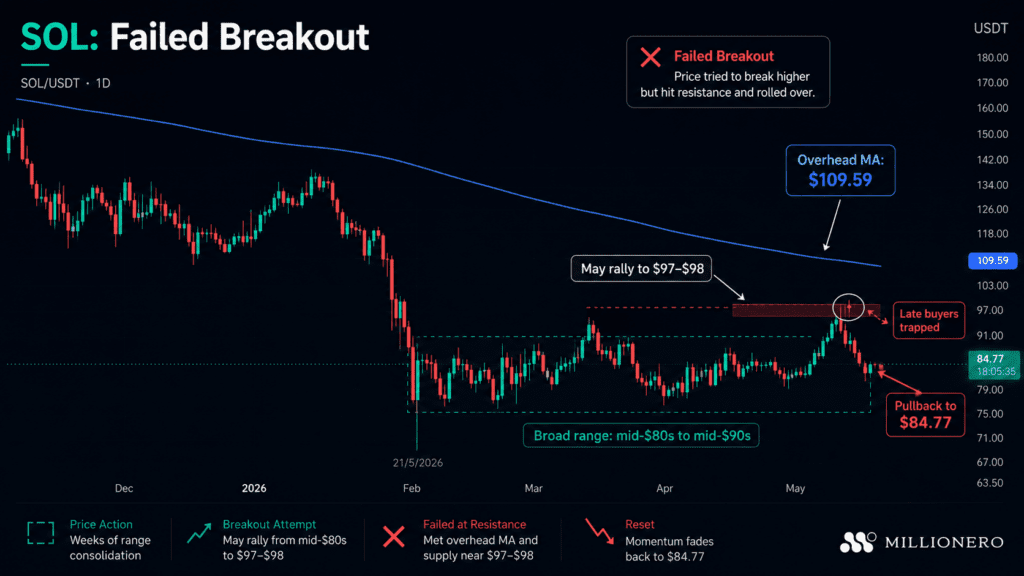
SOL shows the failed-breakout lesson even more cleanly. After spending weeks moving in a broad range, SOL pushed higher in May from the mid-$80s into the $97 to $98 area. That rally looked strong in the moment, and it invited late buyers. Then momentum faded, and price rolled back down toward $84.77. The larger chart still carries overhead pressure as well, with a descending moving average sitting much higher near $109.59. A trader who bought the excitement near resistance entered near local exhaustion and is now trapped in the reset.
The Social Media Trap
Social media gives FOMO a crowd.
A trader may feel calm while watching the chart alone. Then the feed begins to speak. Everyone looks early, sounds certain. Everyone seems to know where price will go next. The trader starts comparing a quiet account to other people’s loud wins.
That comparison is unfair. Most people post the green number, not the risk. They show the result, not the invalidation. They show the confidence, not the fear they felt before entering.
Attention is not analysis. A trending coin deserves research. It does not deserve an automatic buy.
Simple Rules for Slowing Down
FOMO weakens when the trader creates space between emotion and execution.
Wait for a Retest
A breakout becomes healthier when price returns to the breakout level and holds. A retest shows whether buyers still support the move after the first wave of excitement fades. Waiting can cause missed trades, but it also prevents many rushed entries near short-term tops.
Reduce Size When Emotion Is High
Strong emotion should lead to smaller size. A rushed trader has less room to think, manage risk, or accept invalidation. Smaller size reduces panic and keeps the trade under control.
A useful rule is simple: if the trade feels urgent, lower the size.
Avoid Social Media-Only Trades
No trade should begin and end with a post. Social media can introduce an idea, but the chart, risk level, liquidity, and market context must decide the entry. A trade based only on online noise has no structure.
Write the Reason Before Buying
Before entering, write one sentence: I am entering because…
A strong answer includes the setup, invalidation, and risk. A weak answer sounds emotional: because it is pumping, because I missed the first move, or because everyone is calling for higher targets.
The Trade That Leaves Without You
Some trades will leave without you. That is part of trading.
This truth protects the account. The market will always create another setup, another retest, another range, another breakout, another chance to act with a clear mind. The trader who tries to catch every move slowly loses the ability to choose the right ones.
FOMO makes one trade feel like the whole future. Discipline brings the future back into view.
A strong trader can watch a coin pump without entering, strong trader can miss a move and stay calm. A strong trader understands that patience is also a position.
The hardest trade to avoid is the one that seems to be leaving without you. Avoiding it may protect the next trade, the next week, and sometimes the whole account.
Crypto markets move fast, and emotional entries can make them feel even faster. Always do your own research, manage your risk, and treat every trade as your own decision. For more simple crypto education, visit the Millionero Blog, or explore the market directly on Millionero Exchange.