



The new week begins with markets back under pressure after a weekend of renewed tension around Iran, the Strait of Hormuz, and stalled peace talks. Just days after a short-lived relief rally pushed oil lower, stocks to record highs, and Bitcoin above $78,000, the mood has turned again. Oil is rising, futures are lower, and the ceasefire deadline is close.
Crypto is also entering the week with fresh internal damage. A major KelpDAO-LayerZero-Aave exploit shook confidence in DeFi, while the separate RAVE scandal deepened fears about insider manipulation and exchange-listed tokens. That leaves markets balancing geopolitics, crypto stress, and a heavy US calendar that includes Retail Sales, Pending Home Sales, MI Inflation Expectations, and a large wave of S&P 500 earnings.
What Happened Over the Weekend
Hormuz moved back to the center of the market
The weekend opened with a hard turn lower in sentiment. Iranian state media called reports of another round of US-Iran talks in Pakistan false. Its statement said US excessive demands, unreasonable and unrealistic expectations, frequent shifts in positions, continuous contradictions, and the so-called naval blockade had blocked progress. It added that the outlook for constructive talks remains bleak and called the US reports part of a propaganda and blame campaign.
That came after a very messy 48-hour stretch:
- Iran closed the Strait of Hormuz
- The US said peace talks would resume the next day
- Iran backed out of talks
- Iran accused the US of planning a surprise attack
- The US struck and seized an Iranian vessel in the Strait
- Iran denied Trump’s claim that it had agreed to give up uranium enrichment
The broader takeaway was simple: distrust between both sides has become severe. Trump also said no deal this week would be detrimental for Iran.
By early Monday, markets were reacting fast. US stock futures opened sharply lower as talks stalled and Iran closed the Strait again:
- S&P 500: -1.0%
- Nasdaq 100: -1.1%
- Dow Jones: -1.0%
- WTI Crude: +8.5%
- Brent: +8.0%
- Natural Gas: +1.5%
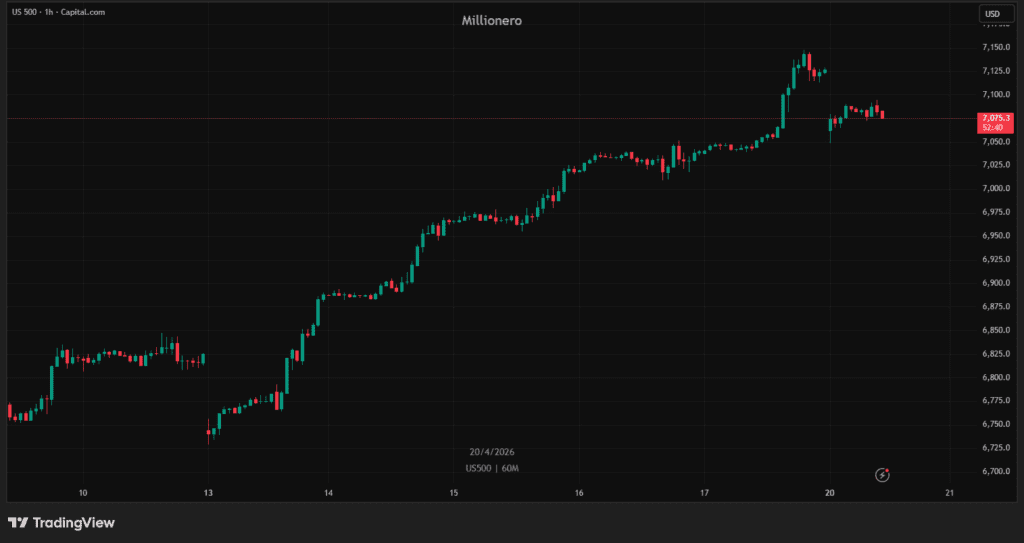
The US-Iran ceasefire is set to expire in two days. At the same time, US oil prices rose 7% and moved above $89 per barrel as markets reacted to the latest closure of Hormuz and Iran’s rejection of new talks.
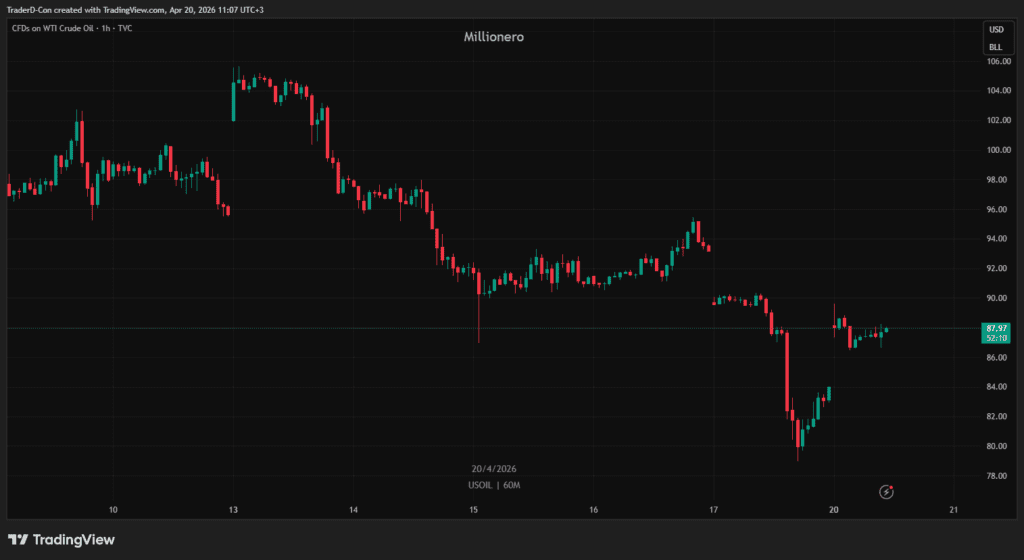
A direct military clash raised the risk level
The weekend then moved beyond headlines and into direct military action. Iran said it attacked US military ships with drones in retaliation for the US striking and seizing an Iranian cargo vessel in the Strait of Hormuz.
That escalation followed a whiplash sequence from Friday. For a short period, the Strait appeared to reopen. Iran’s foreign minister Seyed Abbas Araghchi said commercial passage through Hormuz was open for the remainder of the ceasefire. Trump amplified that message and framed it as part of a larger agreement, including claims that Iran had agreed never to close the Strait again.
Markets reacted immediately. Oil fell more than 10% to 11%, the S&P 500 hit a fresh all-time high, and Bitcoin surged above $77,000 and then above $78,000, reaching about $78,336.
That move reversed after the US market closed. Speaker of Iran’s Parliament Mohammad Bagher Ghalibaf said the Strait would not remain open while the US naval blockade of Iranian ports continued. He accused Trump of making seven false claims in one hour. That denial helped pull Bitcoin back toward the $76,000 area over the weekend, now sitting just under $75k.
On Saturday, the crisis hardened further. The IRGC said it had regained full control and closed Hormuz again until the US lifts the blockade. Reports said IRGC gunboats fired on at least one tanker and one container ship trying to pass, with damage but no confirmed injuries. By Sunday and Monday, Iran’s military said Hormuz was back under strict management and would stay closed.
The broader war backdrop also darkened. Claims emerged that Iran had rebuilt missile and drone stockpiles quickly during the truce window and kept them pointed at Israel. Recent Iranian ballistic missile salvos, including cluster munitions, had already targeted Israeli cities. The overall signal was clear: re-escalation now looks more likely than de-escalation.
Ghalibaf’s Bloomberg-style oil message drew attention
One of the strangest weekend developments came from Ghalibaf’s market language. He commented on “vibe-trading” digital crude oil prices and US Treasuries and ended with the Bloomberg Terminal command “EUCRBRDT Index GP ”, which is the command for Dated Brent oil prices.
The timing stood out because on Friday about $760 million in oil shorts were reportedly placed just 21 minutes before Iran reopened the Strait of Hormuz. Ghalibaf then posted a message that sounded more like a note to commodity traders than a normal political statement.
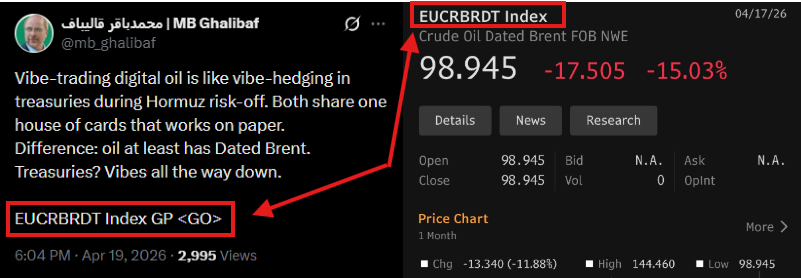
That post reportedly drew more than 2.3 million views within hours. No evidence of illegal insider trading has been presented, but the mix of perfect timing, oil shorts, and trader-style language fueled speculation that Iran understood exactly how the market was pricing the Friday fake-out.
The peace deadline is now a real market event
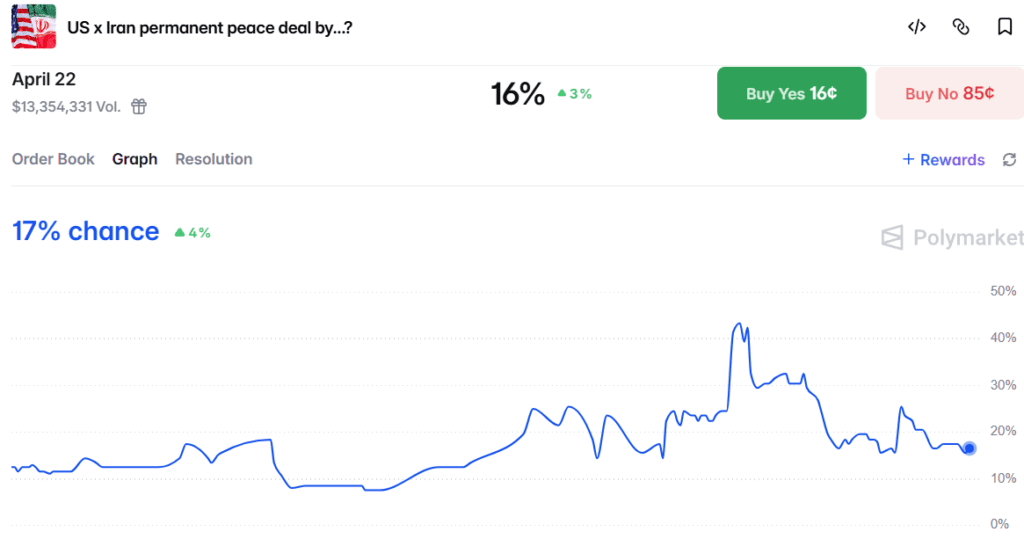
Hopes for a permanent US-Iran peace deal by Wednesday, April 22 have dropped sharply. Polymarket odds for a deal fell to about 19.5% yes, and analysts are now warning that failure could trigger “war phase 2.”
Crypto’s Weekend Damage
The KelpDAO, LayerZero, and Aave exploit became the biggest DeFi hack of 2026
The largest DeFi exploit of the year so far hit on April 18, with about $292 million to $293 million drained.
The setup was simple but damaging:
- KelpDAO is a liquid restaking protocol that gives users rsETH
- LayerZero powers cross-chain messaging and was used in KelpDAO’s bridge
- Aave is the largest DeFi lending protocol and became the main site of the fallout
The attacker targeted KelpDAO’s LayerZero-powered bridge at about 17:35 UTC. KelpDAO had configured LayerZero with a 1/1 DVN setup, meaning only one verifier was needed to approve a cross-chain message. LayerZero recommends 2/2 or more for serious apps, and Kelp had reportedly been warned about the risk 15 months earlier in Aave governance forums.
The attacker sent a forged message through LayerZero’s EndpointV2 contract. The bridge accepted it as valid and minted or released 116,500 rsETH, about 18% of the circulating supply, worth roughly $292 million to $293 million, even though no real ETH had been deposited.
That fake rsETH was then used as collateral on Aave, and also on SparkLend and Fluid, to borrow about $236 million in real WETH before the system was frozen.
KelpDAO paused contracts about 46 minutes later, stopping another $100 million or more from being stolen. But the main damage was already done. Aave and others froze rsETH markets within hours.
The key point is that Aave’s own smart contracts were not hacked. The problem came from KelpDAO’s bridge and the fake collateral. But DeFi’s composability turned one bridge failure into bad debt on Aave.
The fallout was heavy:
- Aave froze rsETH markets on V3 and V4
- Aave’s WETH pool hit 100% utilization, making ETH withdrawals difficult
- $5 billion to $6 billion or more was withdrawn from Aave and other DeFi protocols
- Aave’s TVL fell from about $26 billion to around $20 billion to $21 billion in a day
- AAVE fell 18% to 22%
- ZRO fell about 30%
- Aave activated its Umbrella safety module, a backstop of about $50 million
- Estimated bad debt could reach $177 million to $236 million or more
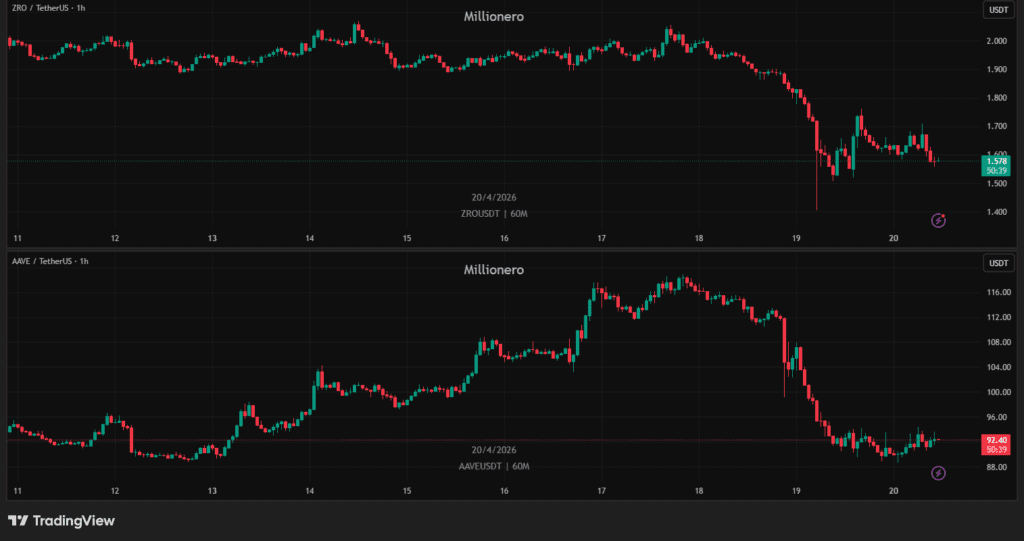
LayerZero said it is working with KelpDAO on fixes, said other apps remain safe, and promised a full post-mortem. It also pointed to the weak 1/1 configuration as a key factor.
The exploit hit DeFi where it hurts most: trust in composability. In a market where many blue-chip DeFi yields are only 2% to 5%, the question is becoming harder to avoid: why take that risk if one bridge misconfiguration can trigger system-wide panic?
The RAVE scandal created a second trust shock
At the same time, RaveDAO and $RAVE became the center of a separate manipulation scandal.
RaveDAO is a web3 entertainment project linked to music festivals and blockchain participation. $RAVE launched in December 2025 on Binance Alpha with a total supply of 1 billion tokens. The biggest red flag was concentration: nine addresses linked to the original distribution and team controlled about 95% of the supply.
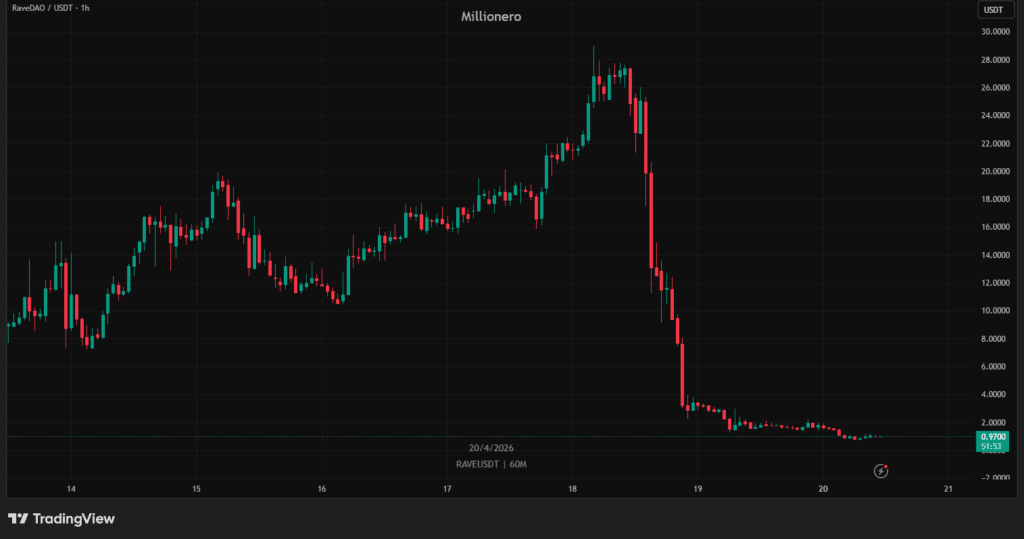
Then came the pump. In about 11 to 14 days, $RAVE rose from about $0.25 to $28. Market cap briefly reached $6 billion, and most of the volume flowed through Binance, Bitget, and Gate.io. Utility and adoption were limited, which made the move look like classic low-float hype backed by concentrated insider holdings.
On April 18 at 07:26 UTC, on-chain investigator ZackXBT publicly accused insiders controlling more than 90% of supply of running a coordinated pump-and-dump. He named the exchanges involved, called on Binance and Bitget to investigate, and offered a $10,000 bounty, later raised to $25,000, for strong whistleblower evidence.
He said he had already confronted RaveDAO co-founder Yemu Xu on April 13 and 14 and got no response.
The same day moved quickly:
- 10:56 UTC: bounty raised to $25,000
- 11:18 UTC: Bitget said it was investigating
- 14:08 UTC: Binance acknowledged the issue
- 15:06 UTC: RaveDAO denied involvement
- 16:19 UTC: Gate acknowledged the issue
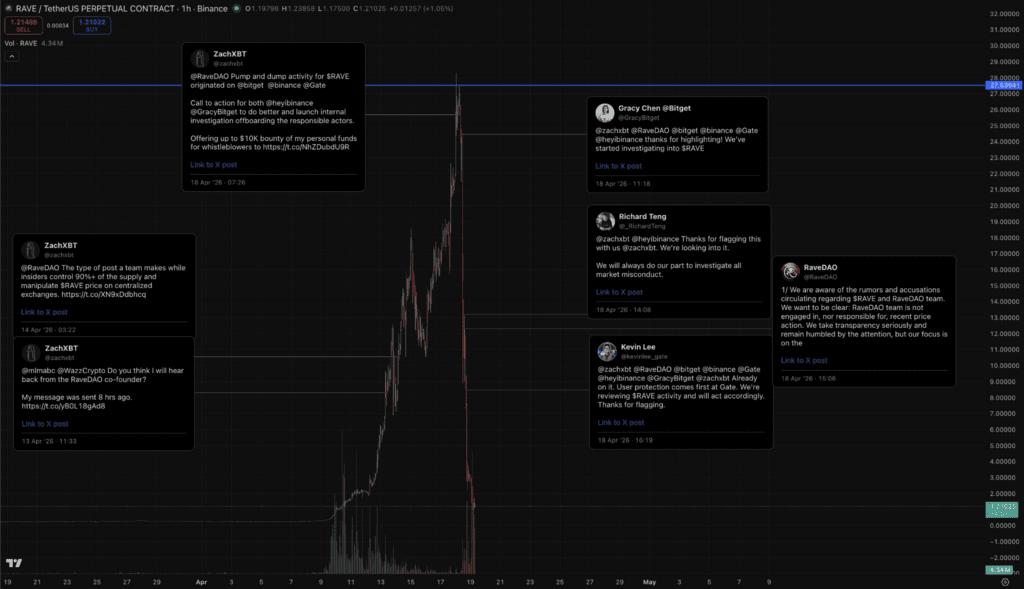
ZackXBT also listed the nine controlling addresses and showed flows from team-linked wallets into Bitget and Gate hot wallets before the crash.
The first crash was brutal. Within 24 hours, $RAVE fell 95% from about $26 to $1. About $52 million in liquidations hit, but more than $6 billion in market value disappeared.
Then a second wave hit. Roughly three hours before a later ZackXBT update on April 19 to 20, a multisig wallet already flagged as one of the original nine distribution addresses sent about 23 million RAVE tokens to two Bitget deposit addresses. At the reduced market price that was worth about $23 million, but at the all-time high it would have been about $600 million.
The market reacted immediately. $RAVE dropped another 40% in minutes, falling from about $1.53 to $0.72.
This mattered because it happened at the same time as the DeFi exploit. One event showed how weak DeFi composability can be. The other showed how dangerous exchange-listed tokens with concentrated insider control can be. Together, they fed the same narrative: confidence in the crypto market is getting hit from multiple sides.
ZackXBT also flagged other tokens with similar patterns, including $SIREN, $MYX, $COAI, $PIPPIN, and $RIVER.
The Week Ahead: US Events and Why They Matter
This week’s main scheduled events are:
- Markets react to Iran closing the Strait of Hormuz – Today 6 PM ET
- 2nd Round of US-Iran Negotiations Begin – Monday
- March Retail Sales data – Tuesday
- March Pending Home Sales data – Tuesday
- April MI Inflation Expectations data – Friday
- ~15% of S&P 500 Companies Report Earnings
The US-Iran ceasefire deadline is currently set for Tuesday.
All of the main US numbers can be read through one simple lens: inflation, growth, the labor backdrop, and the Fed. Retail Sales will show whether consumer demand is still holding up. Pending Home Sales will show whether the housing market is still under rate pressure. MI Inflation Expectations will show whether households think inflation is staying sticky, especially if oil keeps rising because of Hormuz.
Together, these releases help shape expectations for future Federal Reserve rate decisions. Strong demand and rising inflation expectations would make it harder for the Fed to cut. Weaker demand, softer housing, or contained inflation expectations would support the case for easier policy later. Earnings will matter too, because they show whether companies are still managing higher costs and uneven demand without a bigger slowdown.
Token unlocks
LayerZero (ZRO)
Date: April 20, 2026
Unlock Value: 41.65M USD
% of Circulating supply: 5.34%
Number of Tokens: 25.71M ZRO
KAITO (KAITO)
Date: April 20, 2026
Unlock Value: 7.08M USD
% of Circulating supply: 4.93%
Number of Tokens: 17.60M KAITO
Undeads Games (UDS)
Date: April 22, 2026
Unlock Value: 37.09M USD
% of Circulating supply: 13.47%
Number of Tokens: 21.94M UDS
Aerodrome Finance (AERO)
Date: April 23, 2026
Unlock Value: 1.20 USD
% of Circulating supply: 0.00%
Number of Tokens: 3 AERO
SoSoValue (SOSO)
Date: April 24, 2026
Unlock Value: 5.63M USD
% of Circulating supply: 4.35%
Number of Tokens: 13.33M SOSO
Monad (MON)
Date: April 24, 2026
Unlock Value: 5.09M USD
% of Circulating supply: 0.34%
Number of Tokens: 170M MON
Humanity (H)
Date: April 25, 2026
Unlock Value: 10.74M USD
% of Circulating supply: 4.02%
Number of Tokens: 105.36M H
Plasma (XPL)
Date: April 25, 2026
Unlock Value: 9.30M USD
% of Circulating supply: 3.83%
Number of Tokens: 88.89M XPL
Final Outlook
The week is opening from a much weaker place than markets expected on Friday. The peace rally is gone. Oil is back up, futures are down, and the Hormuz story has become unstable again.
Crypto is not getting a clean backdrop either. The KelpDAO-LayerZero-Aave exploit exposed DeFi fragility, while the RAVE collapse exposed how quickly concentrated supply can destroy a token that looked strong only days earlier.
That leaves markets watching two things at the same time: whether the Iran-Hormuz crisis gets worse, and whether US data keeps the Fed cautious or gives markets room to price easier policy later. If geopolitical pressure rises again, oil may stay in control of the macro story. If tensions calm down, attention can shift back toward earnings, consumer demand, housing, and rate expectations.
This article is not financial advice. Always do your own research. You can also do your research on our blog, and when you’re ready, come trade spot and perps on Millionero.