



Weekend Developments: Bitcoin Returned to a Major Level
Bitcoin Breaks Above $80,000
Bitcoin opened the week with a strong move, breaking above $80,000 for the first time in four months, or the first time since January 31. The move came with a wider market lift, as around $70 billion was added to the crypto market today.
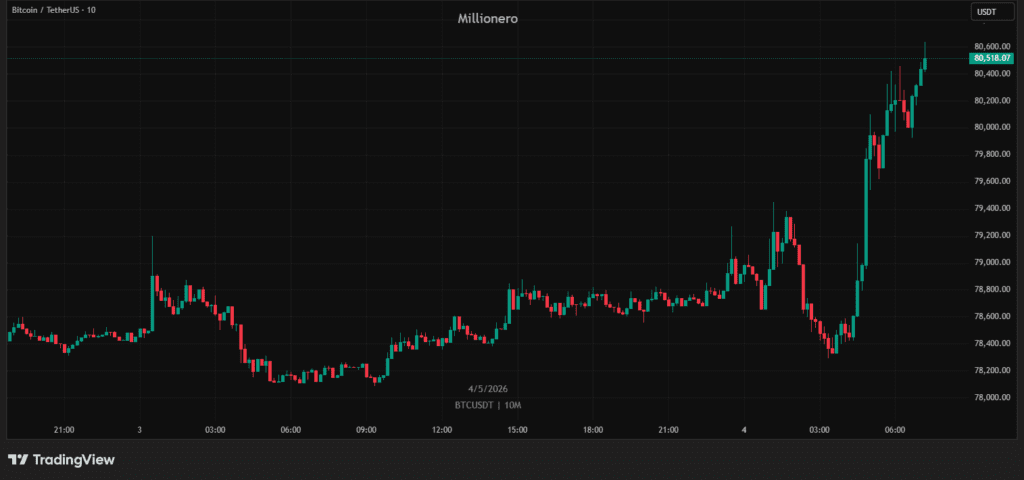
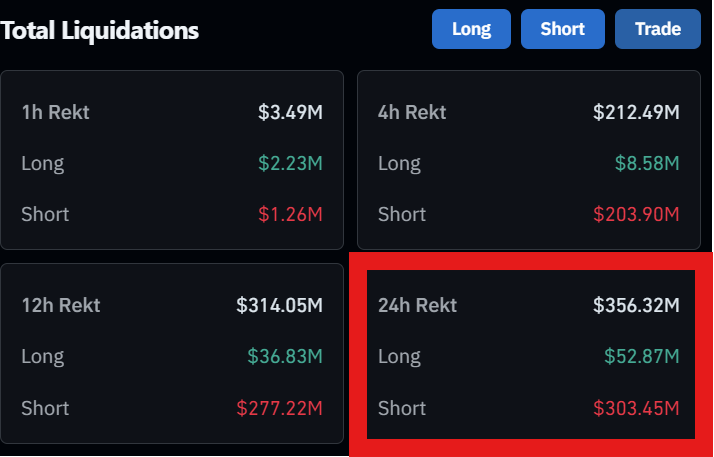
The breakout also hit short sellers hard. In the last 24 hours, more than $303 million in short positions were liquidated, out of $356 million in total liquidations. That shows how much of the recent move was driven by traders being forced out of bearish positions.
For now, Bitcoin is back under a level that carries both technical and psychological weight. The market is watching whether this move can turn into a cleaner trend.
Institutional Bitcoin Demand Remains in Focus
BlackRock’s European Bitcoin ETP Passes $1.1 Billion
BlackRock’s European iShares Bitcoin ETP, IB1T, has now passed $1.1 billion in assets under management. The product holds about 14,200 BTC.
IB1T launched in March 2025 and is listed on major European venues including Euronext Paris, Euronext Amsterdam, and Xetra. Its growth marks another step in BlackRock’s push into Europe’s crypto ETP market.
Bitcoin exposure is becoming easier to access across more regulated markets. It shows that institutional infrastructure around Bitcoin continues to grow.
Morgan Stanley Advises 2%–4% Bitcoin Exposure
Morgan Stanley’s head of digital asset strategy, Amy Oldenburg, said at Bitcoin Conference that Bitcoin could eventually enter U.S. bank balance sheets. However, she also said that this path will likely take longer than markets expect.
The barriers remain serious: Federal Reserve guidance, Basel rules, and regulatory requirements across multiple jurisdictions still shape how banks can treat Bitcoin exposure.
Morgan Stanley is currently advising clients to allocate 2%–4% to Bitcoin. Adoption among financial advisers remains slower, mostly because of education and awareness gaps. Still, the number itself matters.
Michael Saylor Points to a “Cambrian Explosion” in Crypto
Strategy’s Bitcoin Buying Is No Longer Quiet
Michael Saylor, founder and executive chairman of Strategy, said at Bitcoin 2026 Las Vegas on April 28, 2026, that the crypto industry may be entering a Cambrian-style boom.
His focus was the global $3.5 trillion private credit market, which he described as facing liquidity constraints. In his view, even a small inflow of capital could open strong growth in the digital credit sector and create new room for crypto.
This speech is becoming more important . As it appears that Strategy’s Bitcoin buying behavior has changed.
In the past, Saylor’s Bitcoin accumulation was usually much quieter. Strategy’s buys were often understood as more secretive, broken into smaller pieces through methods like TWAP, with orders cut across the order book to reduce market impact.
Now, the market is watching a different structure: STRC, Strategy’s preferred stock.
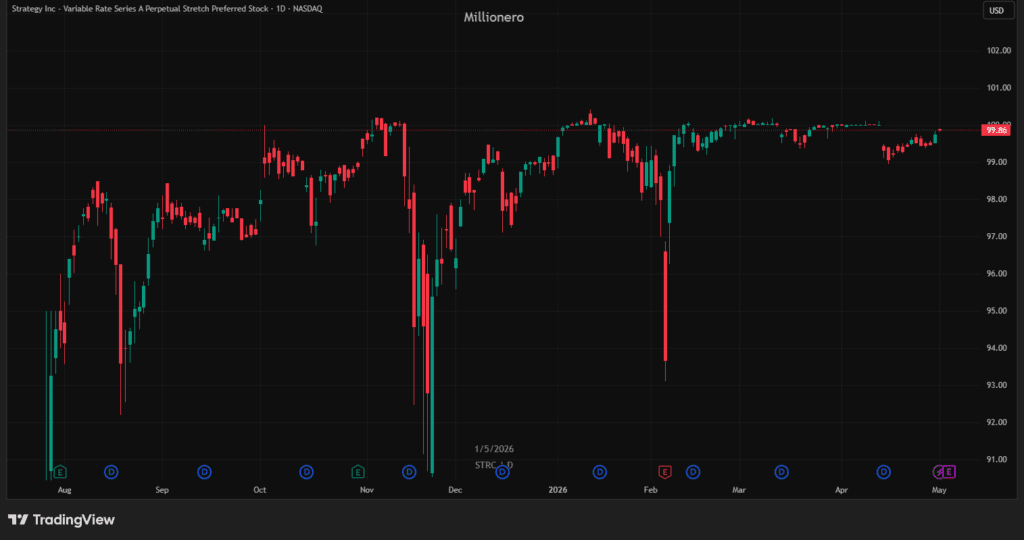
In very simple terms, STRC works like a capital flywheel. It resets around the 15th of the month, slowly climbs back toward $100, and then Strategy can issue more stock to raise cash. That cash can then be used to buy more Bitcoin.
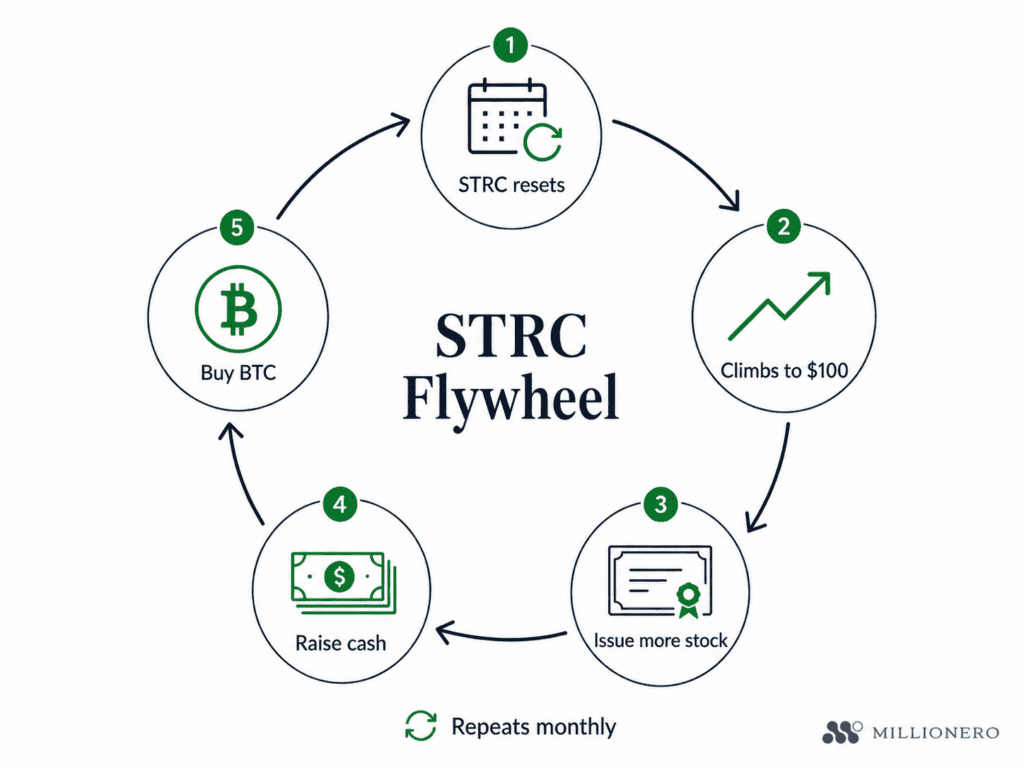
This matters because Strategy is no longer just buying Bitcoin quietly in the background. With this structure, Saylor can raise large amounts of cash and buy billions of dollars’ worth of BTC when conditions allow. That kind of buying can show up in price action.
So it is reasonable to assume that Strategy has contributed to the rally in two ways: directly through actual Bitcoin purchases, and indirectly through sentiment. When traders know that one of the largest corporate Bitcoin holders may continue buying aggressively, it changes how the market reads supply, demand, and momentum.
Saylor also argued that rising digital capital inflows could increase Bitcoin demand, possibly creating a Bitcoin supply shortage. If that happens, it could support Bitcoin’s price and strengthen crypto treasury-related sectors.
Crypto Activity Beyond Bitcoin
Bitcoin Mining Stocks Show Strength
Bitcoin mining stocks have also improved in 2026. All of the top 10 publicly listed Bitcoin mining companies have posted positive performance since the beginning of the year.
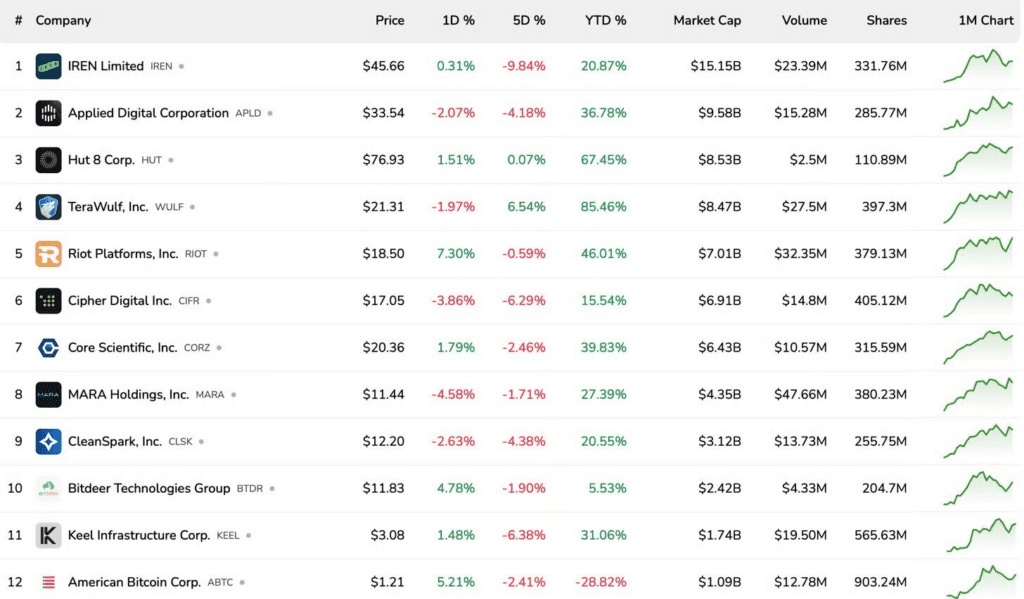
That points to a better mining environment, helped by rising Bitcoin prices and stronger liquidity. When Bitcoin climbs, miners often become one of the clearest equity-market expressions of that move.
Crypto Card Spending Surges
Crypto card spending has also grown sharply. Spending has risen by 500% since September 2024, while monthly volume has reached about $600 million.
In March 2026, crypto card volume reached $606 million. Visa processed 90% of transactions. By network, TRON accounted for 35%, while BNB Chain accounted for 15%.
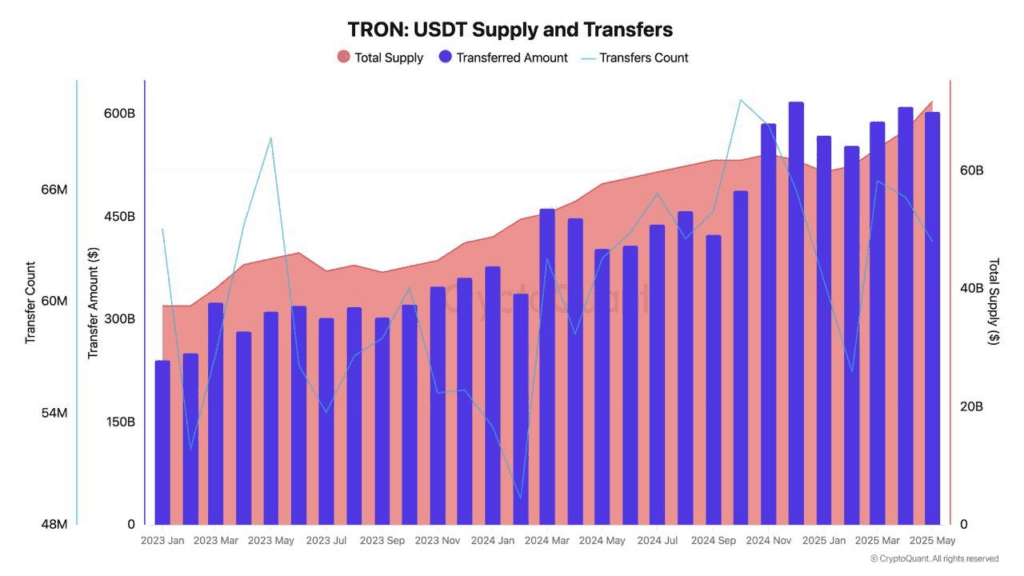
Southeast Asia remains one of the strongest regions for this activity, making up 60% of stablecoin payment volume. Local card issuances also jumped 83-fold between 2024 and 2025.
This adds another layer to the stablecoin story. Stablecoins are not only being used for trading or DeFi. In some markets, they are becoming part of everyday payment rails.
Bitcoin Community Debates Quantum Risk
Quantum computing risk returned to the Bitcoin discussion. Alex Thorn, head of research at Galaxy Digital, said the Bitcoin community has started to reach a preliminary consensus on the issue.
The prevailing view is that Satoshi Nakamoto’s coins should not be touched, even in the face of future quantum concerns. The reason is tied to Bitcoin’s core ownership principle: coins should not be moved or altered by social decision.
One key detail stands out. Satoshi’s balances are spread across about 22,000 addresses, with 50 BTC per address. That makes the debate both technical and philosophical. It is not only about future security. It is also about whether Bitcoin’s rules should remain untouched, even under pressure.
Taiwan Studies Bitcoin as a Reserve Asset
Taiwan is considering whether Bitcoin should be included in its reserves. A Taiwanese legislator called for studying the allocation of part of the country’s $602 billion reserve into BTC.
The argument comes from reserve concentration risk. About 80% of Taiwan’s reserve is held in U.S. dollars, which creates exposure to a possible dollar decline or rising geopolitical tension.
The proposal frames Bitcoin as an asset that cannot be frozen, seized, or controlled by another country. That places Bitcoin inside a much larger debate about reserves, sovereignty, and financial security.
Macro Pressure: Inflation, Oil, and Geopolitics
Powell Calls Inflation Data “Bad News”
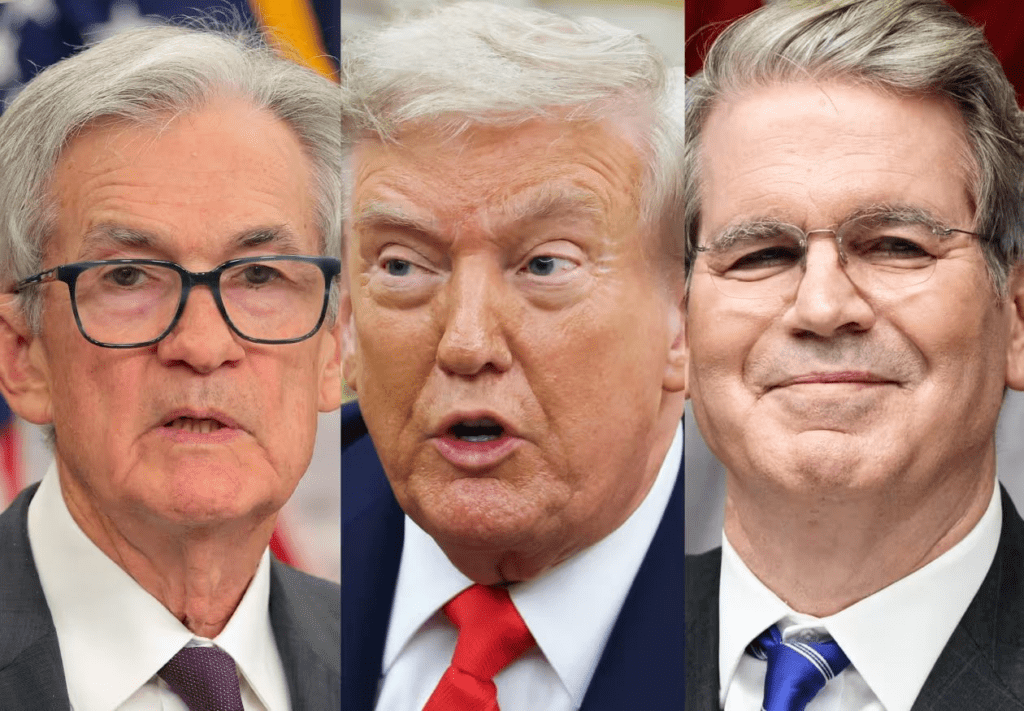
Federal Reserve Chair Powell described the latest inflation data as “bad news.” That comment keeps inflation at the center of market expectations.
For markets, the issue is not only whether inflation is high or low. It is whether inflation is cooling fast enough for the Fed to feel comfortable cutting rates later. If inflation remains sticky, rate-cut expectations weaken. If inflation cools while growth holds, risk assets can find more support.
That is why this week’s labor data matters so much. The Fed is watching inflation, but it is also watching whether the labor market is softening in a controlled way.
Buffett Warns About a Gambling Mindset
Warren Buffett also warned that U.S. markets have never before seen this many investors with a “gambling” mindset. At the same time, he said opportunities still exist.
That balance fits the current market well. Speculation is clearly high, especially when major moves are followed by large liquidations. But strong markets can still create real opportunities when earnings, liquidity, and macro conditions align.
Strait of Hormuz Tension Hits Oil
Geopolitical risk remained active over the weekend. Trump warned that strikes could resume if “Iran misbehaves,” while also confirming that the Iranian proposal is still under review and that he is dissatisfied with it.
Iran responded by saying war with the United States is “likely to resume soon.” Negotiations are still ongoing, but escalation remains on the table.
The Strait of Hormuz remained central to the story. Trump said the Strait of Hormuz is “100% closed,” while talks with Iran are continuing with “no progress.” He also framed the situation sharply: “Either we hit them… or we reach a deal.”
Oil prices reacted at Monday’s open, falling more than 2% after Trump announced that the U.S. would assist in freeing ships stranded in the Strait of Hormuz.
Oil remains important because it feeds directly into inflation expectations. A sharp oil rise can make inflation fears worse. A drop in oil can ease some pressure, but only if geopolitical risk does not return quickly.
The Week Ahead: Labor Data, Fed Speakers, and Earnings
U.S. Data Takes the Main Stage
This week is built around the U.S. labor market. The market is entering the week with Bitcoin above $80,000, inflation still uncomfortable, and the Fed still careful. That makes every labor number more important than usual.
The calendar is direct:
- Tuesday: JOLTS Job Openings data for March and ISM Services Index for April
- Wednesday: ADP Employment data for April
- Friday: U.S. Jobs Report
- All week: Around 11 Fed speeches
- Earnings: About 20% of S&P 500 companies report results
The focus is not only on whether the economy is strong. The focus is whether it is too strong for rate cuts.
If job openings stay high, hiring remains firm, and wages show pressure, the market may read it as a sign that the Fed has less room to ease policy. That could make rates stay higher for longer and create pressure for stocks and crypto.
If the data shows a cooler labor market without a sharp breakdown, the market may take it more positively. That would support the idea that inflation can continue to slow while the economy avoids a hard landing.
This is the line markets are watching now: cool enough for rate cuts, but not weak enough to scare investors.
Earnings Season Adds a Short-Term Catalyst
Earnings also matter this week. The majority of US500 earnings reports will be done this week, which gives markets a clearer view of how companies performed in the first quarter.
Historically, strong Q1 earnings can create a short-term bullish catalyst because they reset market confidence after the early-year uncertainty. If companies show solid revenue, stable margins, and confident guidance, stocks can continue to support broader risk sentiment.
The biggest remaining earnings event is still Nvidia, scheduled for May 20. Nvidia remains important because it sits at the center of the AI trade, the semiconductor cycle, and the broader market’s growth narrative.
So while labor data will guide rate expectations, earnings will shape whether investors still believe the corporate side of the market is strong enough to carry the rally.
Token Unlocks
Rain (RAIN)
Date: May 10, 2026
Unlock Value: 397.51M USDT
% of Circulating supply: 4.37%
Number of Tokens: 50.28B RAIN
Pyth Network (PYTH)
Date: May 20, 2026
Unlock Value: 100.16M USDT
% of Circulating supply: 21.3%
Number of Tokens: 2.12B PYTH
LayerZero (ZRO)
Date: May 20, 2026
Unlock Value: 36.78M USDT
% of Circulating supply: 2.57%
Number of Tokens: 25.71M ZRO
Stable (STABLE)
Date: May 8, 2026
Unlock Value: 29.44M USDT
% of Circulating supply: 0.89%
Number of Tokens: 888.8M STABLE
ADI Chain (ADI)
Date: May 9, 2026
Unlock Value: 28.41M USDT
% of Circulating supply: 0.70%
Number of Tokens: 6.99M ADI
Pieverse (PIEVERSE)
Date: May 14, 2026
Unlock Value: 26.97M USDT
% of Circulating supply: 3.97%
Number of Tokens: 39.74M PIEVERSE
Humanity Protocol (H)
Date: May 25, 2026
Unlock Value: 20.18M USDT
% of Circulating supply: 1.05%
Number of Tokens: 105.35M H
Ethena (ENA)
Date: May 5, 2026
Unlock Value: 17.3M USDT
% of Circulating supply: 2.12%
Number of Tokens: 171M ENA
Opinion (OPN)
Date: May 5, 2026
Unlock Value: 5.3M USDT
% of Circulating supply: 12.22%
Number of Tokens: 32.09M OPN
RedStone (RED)
Date: May 7, 2026
Unlock Value: 5.5M USDT
% of Circulating supply: 12.2%
Number of Tokens: 40.85M RED
Space and Time (SXT)
Date: May 8, 2026
Unlock Value: 6.1M USDT
% of Circulating supply: 23.2%
Number of Tokens: 387M SXT
Final Outlook
The market enters the week with momentum, but also with pressure points. Bitcoin has reclaimed $80,000, short sellers have been flushed out, institutional Bitcoin products continue to grow, and crypto payment activity is rising.
At the same time, inflation remains uncomfortable, oil is still tied to geopolitical risk, and the Fed is waiting for more labor market evidence before changing its tone.
This week’s setup is clear: labor data will guide rate expectations, earnings will test equity confidence, and Bitcoin will try to prove that the $80,000 breakout is more than a short squeeze.
As always, this is not financial advice. Keep doing your own research, follow the data closely, and read more market updates on the Millionero blog. You can also trade crypto spot and perpetuals on Millionero.