



Arbitrum’s Security Council moved fast this week, freezing 30,766 ETH, roughly $71 million, tied to the KelpDAO exploit. The funds were pushed into an intermediary wallet that can only be touched through further governance action, effectively pulling them out of the attacker’s reach.
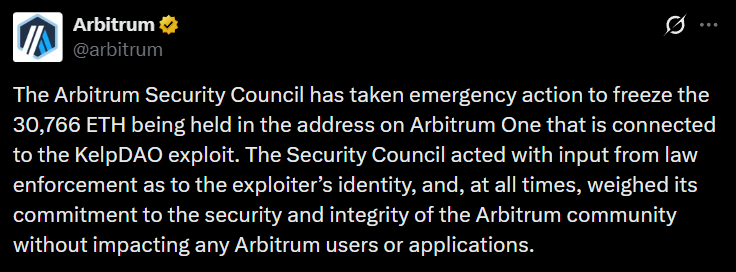
It’s a clean win on a very ugly week. It’s also nowhere near the full story.
What Actually Broke
The exploit drained somewhere between $292 million and $293 million. The recovered chunk is about a quarter of that. But the more interesting part isn’t the size, it’s the mechanism.
Kelp’s main smart contracts didn’t fail. The bridge layer did. The attacker:
- Pushed a fake cross-chain message through a verification setup that trusted a single checker
- Got roughly 116,500 rsETH minted or released without real backing
- Walked that synthetic collateral over to Aave and borrowed real ETH against it
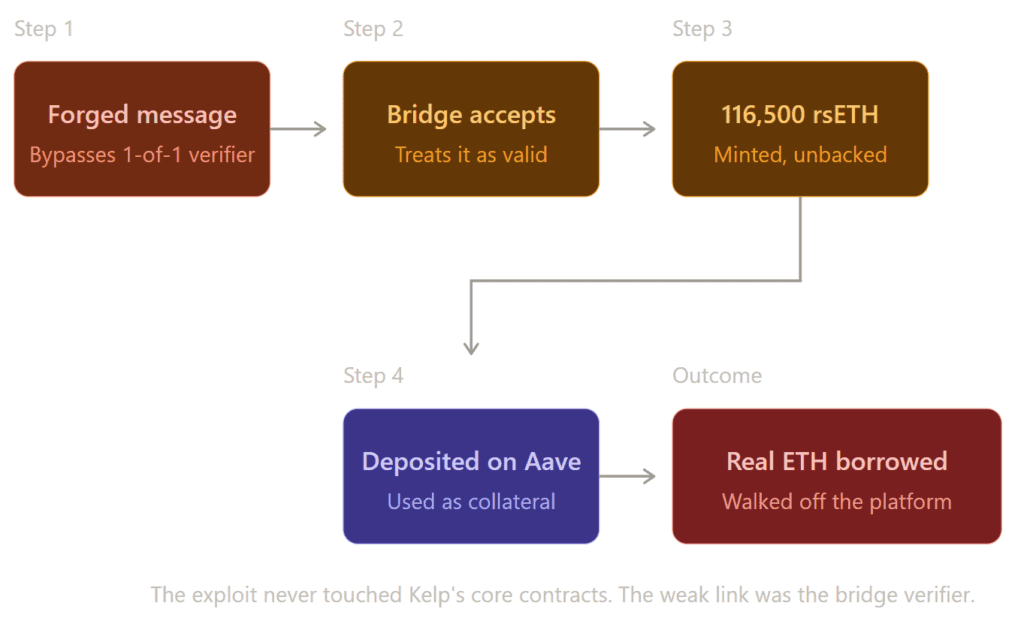
The system broke because the infrastructure accepted a forged message as real.
The Blame Fight
This is where it gets uncomfortable.
LayerZero pointed at Kelp’s 1-of-1 verifier configuration, one checker, no second safety layer, and argued a stronger multi-verifier setup would have caught the forged message. Kelp pushed back, saying the configuration at the heart of the exploit reflected LayerZero’s own default and the guidance Kelp received during integration.
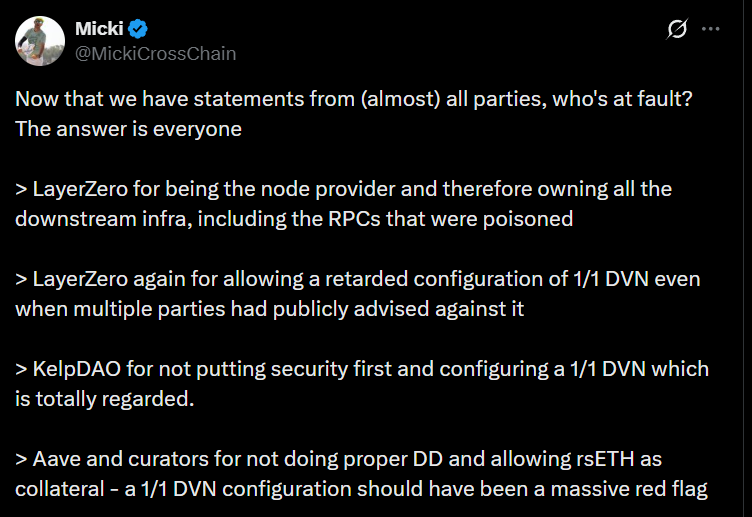
Both things can be true, and that’s the problem.
- If this was purely a Kelp mistake, other projects can shrug it off as bad config
- If a weak default was sitting in front of a lot of integrations, the surface area for the next version of this attack is much larger than anyone wants to admit
The Hole That’s Still Open
Freezing $71 million helps. It doesn’t close the gap.
Aave’s risk manager has laid out two rough scenarios for how the remaining damage lands:
- Lighter path: about $123.7 million in bad debt distributed across rsETH holders
- Heavier path: closer to $230.1 million concentrated on Ethereum L2s like Arbitrum and Mantle
Either way, somebody absorbs the loss. The recovery headline doesn’t change that math much. It just reduces the size of the argument.
What the Freeze Says Out Loud
Arbitrum’s move worked. It was fast, coordinated, and reportedly done with law enforcement input. Normal users and apps on the chain weren’t disrupted.
It also quietly reminded everyone that “decentralized” still has an emergency brake, and a small council holds it. That’s useful when $71 million is walking out the door. It’s less comfortable if you believed the marketing about no one being able to intervene.
You can’t have it both ways, and this week the market quietly chose intervention. Worth noting for next time someone argues the opposite.
Why Traders Panicked
The mood across DeFi wasn’t just anger at Kelp. It was fear of contagion.
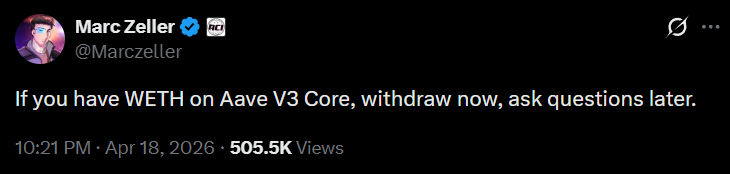
When one token lives across bridges, lenders, and layered protocols, a single failure in the middle travels in every direction at once. People pulled funds from lending platforms in a run-like move, not because they thought Aave was broken, but because they couldn’t quickly tell what else might be standing on the same weak assumption.
That’s the real tell. The panic was about not knowing where the next 1-of-1 verifier is hiding.
The Takeaway
DeFi is only as decentralized as its weakest middle layer.
Users watch the front end, the token, the chain. The risk sits in the quiet part underneath:
- The bridge
- The verifier
- The oracle
- The stuff nobody audits publicly and nobody talks about until it breaks
Arbitrum proved crypto can move quickly to freeze stolen money. This exploit proved it still moves slowly on the design choices that let the theft happen in the first place. Recovering a quarter of the loss is a good day. It isn’t a fix.
This article is for informational purposes only and does not constitute financial advice. Please DYOR. You can also DYOR on blog.millionero.com. When ready, trade spot and perps on Millionero.