


From Deadline Drama to a Sudden Pause
Just hours before President Trump’s 12 AM UTC deadline, the market was still bracing for another escalation. Reports said a ceasefire deal was expected to be closed that night, while Pakistan asked for a two-week extension to the deadline. The White House said a response would come, Iran said it was positively reviewing Pakistan’s proposal, and US and Arab officials said the talks were no longer centered on a full deal, but on getting a deadline extension.
That was the setup. Then the story changed fast.
Trump announced that the US would suspend attacks on Iran for two weeks on the condition that Iran would reopen the Strait of Hormuz. He described it as a “double sided ceasefire.” That immediately turned the focus away from whether strikes would continue and toward a bigger question: whether this short pause could become the start of a real end to the war.
The Two-Week Ceasefire Was Built Around Hormuz
This was not a simple pause
The full outline of the ceasefire made clear that this was more than a symbolic cooling-off period. The two-week pause was made subject to Iran agreeing to the “complete, immediate, and safe opening” of the Strait of Hormuz. Trump said the arrangement was brokered by Pakistan, that the US had already met and exceeded all military objectives, and that Washington and Tehran were already far along with a definitive agreement for long-term peace.
He also said Iran’s earlier 10-point proposal was a workable basis, and that this two-week window would be used to finalize a broader agreement.
Iran did not confirm immediately, but then the picture became clearer
At first, there was a noticeable gap between Trump’s announcement and Iran’s response. For around 20 minutes, markets had no confirmation from Tehran. That delay mattered because the whole arrangement depended on Iran agreeing to reopen Hormuz.
Then Iran’s Foreign Minister Araghchi said that safe passage through the Strait of Hormuz would be possible through coordination with Iran’s Armed Forces and with due consideration of technical limitations. He also said that if attacks against Iran were halted, Iran’s armed forces would stop their defensive operations.
That was the point when the market began treating the ceasefire as real. Soon after, the story developed further into a broader two-week ceasefire between Iran, Israel, and the US
Iran’s Terms Show Why This May Matter Beyond Two Weeks
Tehran framed the outcome as acceptance of its plan
Iran later said it had forced the US to accept its 10-point plan, and those terms show why this moment could be much bigger than a short truce. According to Iran, the framework includes:
- Commitment to non-aggression
- Iran’s control over the Strait of Hormuz
- Acceptance of Iran’s uranium enrichment
- Lifting of all primary sanctions
- Lifting of all secondary sanctions
- Termination of all UN Security Council resolutions
- Termination of all Board of Governors resolutions
- Paying compensation to Iran
- Withdrawal of US combat forces from the region
- Cessation of war on all fronts, including Lebanon
Trump said this plan is a workable basis. That matters because it pushes the story beyond a temporary military pause and into the territory of a possible political settlement.
Hormuz is the real heart of the deal
The most important part of all this is still the Strait of Hormuz. If it stays open, the whole global market feels the difference immediately. If it closes again, the relief could disappear just as fast.
The new plan also reportedly allows Iran and Oman to charge fees on ships crossing the Strait of Hormuz, with that money expected to go toward Iran’s reconstruction. Iran has recently been charging $2 million for a one-way voyage through the strait.
Trump later added that the US would help with the traffic buildup in Hormuz, that Iran could begin reconstruction, and that the US would be loading up with supplies and just “hanging around” to make sure the arrangement holds. He even said this could become the “Golden Age of the Middle East.”
Markets Reacted Like the Worst Case Was Suddenly Off the Table
Oil collapsed first
The clearest reaction came in oil. After the ceasefire announcement, US oil prices fell nearly 10%, dropping below $101 per barrel. The move did not stop there. Prices then slid to $97.50 per barrel, down 20% in eight hours, then 21%, and later as much as 23% from the high of the day once the US, Iran, and Israel were all seen as part of the ceasefire picture.
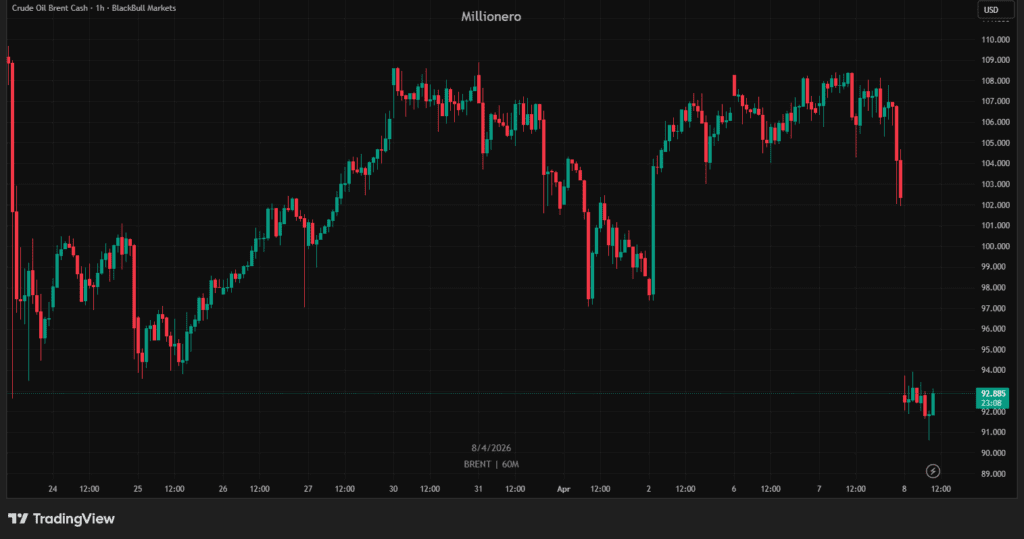
That move said one thing very clearly: the market immediately priced in a much lower risk of supply disruption.
Bitcoin and equities moved the other way
Bitcoin reacted just as sharply in the opposite direction. It first surged above $71,000 after the announcement, then moved above $72,000 as markets gained confidence in the ceasefire.
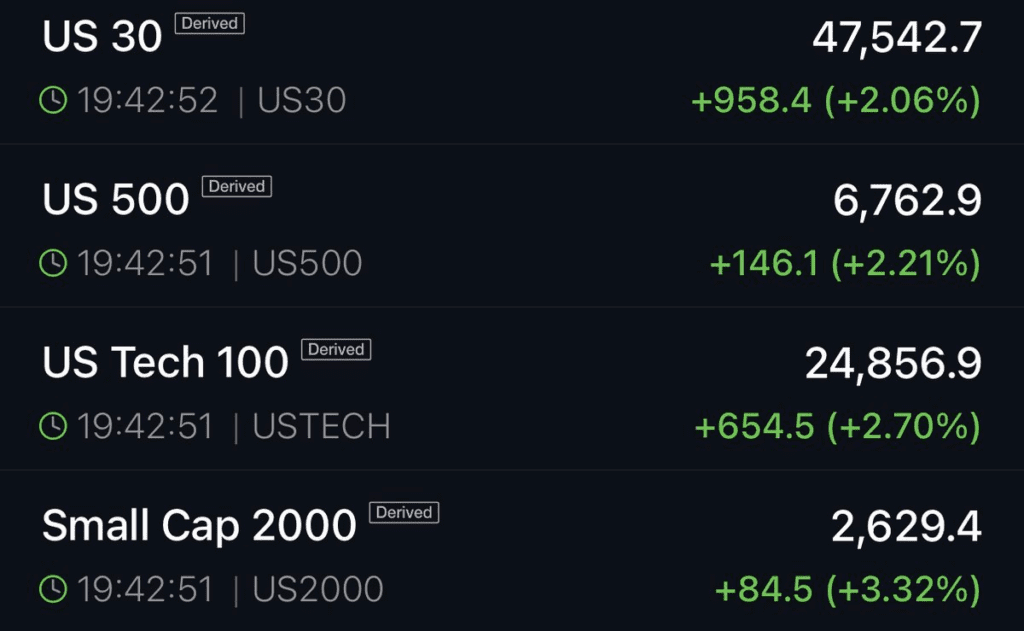
At the same time, the S&P 500 moved toward 6,800, putting it only about 3.5% below a new record high. Gold pushed toward $4,900 per ounce, silver moved toward $77 per ounce, and Japan’s stock market jumped more than 5% in its first reaction.
A broader market snapshot showed the same risk-on tone:
Why the Rally Spread Beyond the Ceasefire Headline
The market was already set up for a strong rebound
The ceasefire did not arrive in an empty market. Under the surface, there was already a strong case for a broad rebound if the war risk cooled. Inflation expectations had risen, the AI Revolution was still expanding, and the Magnificent 7 were still on track to spend more than $600 billion in AI CapEx this year.
At the same time, exposure to equities had dropped sharply during the volatility. That meant there was a large amount of capital still waiting on the sidelines.
In other words, once the market got even a temporary sign that the war might be slowing down and Hormuz might reopen safely, there was already money ready to move back into risk assets.
Why This Story Matters Now
This ceasefire is only set for two weeks, so it is not a final peace deal yet. But it is still one of the biggest shifts in the war so far, because it directly links a military pause to the reopening of the Strait of Hormuz and to a framework both sides now seem willing to keep discussing.
That is why this story matters far beyond one night of headlines. If Hormuz stays open and the two-week pause leads to a larger agreement, markets may look back at this as the moment the war started moving toward its end. If the deal breaks down, then the move in Bitcoin, oil, and global equities will look like a relief rally that ran ahead of reality.
For now, though, the message from the market is unmistakable: the opening of Hormuz changed everything.
This article is for general information only and should not be considered financial advice. Markets can react quickly to war headlines, oil moves, and policy changes. Read our blog for more market coverage, and if you decide to act, trade responsibly on Millionero.