


A Big Bank Has Now Entered the Spot Bitcoin Product Race
Morgan Stanley has officially entered the US spot Bitcoin product market with the launch of Morgan Stanley Bitcoin Trust, trading under the ticker MSBT on NYSE Arca. The launch matters because Morgan Stanley says it is the first US bank-affiliated asset manager to offer a cryptocurrency exchange-traded product, bringing one of Wall Street’s largest names deeper into digital assets.
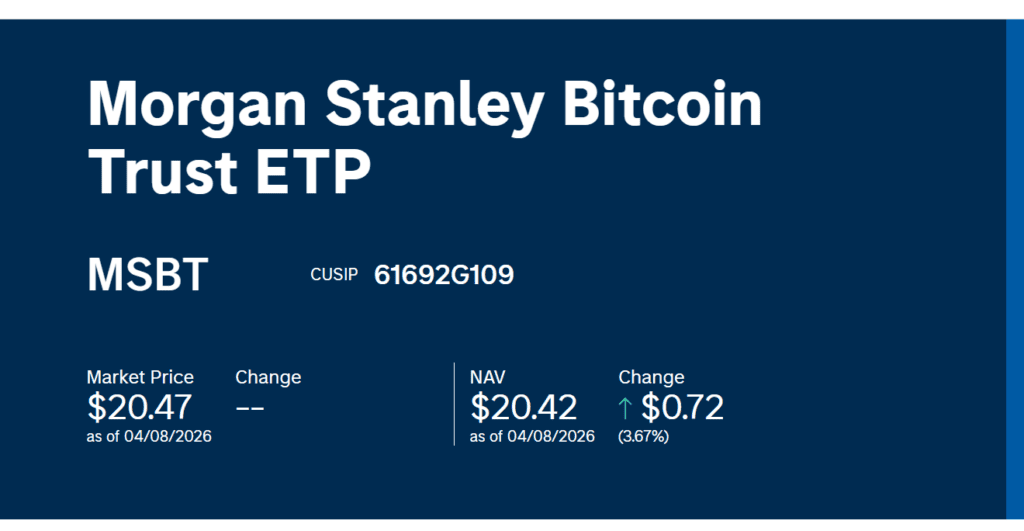
The early trading was closely watched, and the first session gave the market a clear number to work with. MSBT finished its debut day with about 1.66 million shares traded, which put first-day activity at roughly $34 million based on its closing price. The fund closed at $20.47, after opening at $20.80 and trading in a day range of roughly $20.29 to $20.80.
That is not enough to challenge the largest spot Bitcoin funds on day one, but it is a meaningful start for a new entrant that is backed by one of the most established names in traditional finance.
Why This Launch Stands Out
Morgan Stanley is not entering as a niche player
This is not just another fund launch. Morgan Stanley is entering the market with a product that combines brand recognition, distribution power, and pricing pressure. The fund’s sponsor fee is 0.14%, which Morgan Stanley says is currently the lowest bitcoin ETP sponsor fee in the market.
That fee matters because spot Bitcoin funds are increasingly competing on a short list of factors: cost, access, liquidity, and trust. Since many of these products hold the same underlying asset, even small fee differences can matter over time, especially for long-term investors.
It also comes with a built-in distribution network
Another reason this launch is important is Morgan Stanley’s advisory reach. The firm’s wealth platform includes around 16,000 financial advisors, and that gives it a much larger in-house distribution channel than many newer crypto-native competitors.
That does not guarantee immediate dominance, but it does mean Morgan Stanley can place its own Bitcoin product directly in front of a very large client base. In practical terms, this is one of the most important differences between MSBT and smaller issuers that still need to fight for every allocation from outside platforms.
What MSBT Actually Offers
The fund is built for traditional brokerage access
Morgan Stanley is clearly positioning MSBT as a product for investors who want Bitcoin exposure inside a familiar investment structure. Its own launch and marketing materials focus on ease of access, lower operational burden, and integration with traditional portfolios.
The comparison is straightforward:
- With a crypto ETP, access comes through a brokerage account
- With direct ownership, access comes through a digital wallet
That difference shapes the rest of the investor experience. In the ETP structure, custody is handled by the investment vehicle, operational complexity is lower, and the position sits alongside traditional assets. With direct ownership, the investor manages the wallet and infrastructure directly, even though that can provide more direct control over the asset itself.
Morgan Stanley’s marketing message is clear
The firm is presenting Bitcoin in familiar portfolio language rather than crypto-native language. Its materials highlight three main reasons to own Bitcoin:
- Portfolio allocation potential, where Bitcoin may serve as a satellite or opportunistic position inside a diversified portfolio
- Inflation and currency considerations, where it may offer diversification in environments shaped by inflation or currency debasement
- Digital asset exposure, giving investors access to a decentralized digital asset network that operates independently of traditional financial intermediaries
At the same time, Morgan Stanley is also explaining why it believes MSBT specifically fits that role.
Why Morgan Stanley Is Pushing MSBT
Governance, cost, and custody are at the center of the pitch
Morgan Stanley’s product materials focus on three points.
First: governance and oversight. The fund is promoted as a bank-backed product with strong institutional rules, reporting, and risk management.
Second: cost-efficient. MSBT offers Bitcoin exposure through a clear, exchange-traded product with a very low fee of just 0.14%, which makes it even more attractive.
Third: custody and security. Morgan Stanley says the product uses top-level custody arrangements designed to keep assets safe, meet regulations, and operate reliably.
These points show how large traditional firms are selling Bitcoin to clients.
How the Product Is Structured
The benchmark and service providers matter
MSBT aims to follow Bitcoin’s price using the CoinDesk Bitcoin Benchmark at 4 PM New York time. This means the product simply tracks a well-known price index, instead of using an active investment strategy.
On the operations side, Coinbase and BNY were chosen to hold the digital assets. BNY also takes care of administration, transfer agent duties, accounting, recordkeeping, and cash management.
This combination matters because it connects the product to the kind of trusted systems that big, traditional investors already know well.
What the Launch Means for the Broader ETF Market
MSBT is entering a market already led by giants
Morgan Stanley is not entering an empty field. Existing spot Bitcoin products, especially large funds such as BlackRock’s IBIT, already hold tens of billions of dollars in assets and have a major lead in scale and liquidity.
That means MSBT’s first-day trading does not suddenly change the market hierarchy. But it does add a serious new competitor. Morgan Stanley brings a lower fee, a recognizable brand, and a wealth-management channel that could become increasingly important if more investors buy Bitcoin through advisors instead of directly through exchanges.
The bigger story is institutional normalization
The deeper story here is that Bitcoin exposure is becoming more embedded inside traditional finance. Morgan Stanley is not launching a product aimed only at crypto specialists. It is building a product that fits the logic of wealth management, portfolio construction, institutional governance, and brokerage-based access.
That is why the launch matters even beyond its first-day numbers. Roughly $34 million in debut trading volume is solid, but the more important signal is who launched the product and how they are framing it.
Final Take
Morgan Stanley’s launch of MSBT marks another step in the institutional shift of Bitcoin investing. The product opened with about 1.66 million shares traded and roughly $34 million in first-day volume, while also arriving with the lowest fee in its category at 0.14%.
More importantly, Morgan Stanley is packaging Bitcoin in a way that fits the traditional investment world: brokerage access instead of wallet management, institutional custody instead of personal storage, and portfolio language instead of crypto-native messaging.
The day-one volume is only the first signal. The larger question now is whether Morgan Stanley’s advisor network, pricing, and brand strength can turn MSBT into a long-term force in the spot Bitcoin market.
This article is for general information only and should not be considered financial advice. Bitcoin and ETF-related markets can move quickly, especially as institutional products attract new attention. Read our blog for more market coverage, and if you choose to act, trade responsibly on Millionero.